All that reminds him of a country fair.
Admits there's a lot of old dust
And the daylight is the color of sepia,
Just like this picture postcard
With its two lovers chastely embracing
Against a painted cardboard sunset.
I felt really vulnerable starting my blog up again.
Now I realise I needn't of worried. No-one's going to read it. Unless I make them.
I started blogging in December 2006. Fun fact: I registered my blogspot account because I wanted to leave a comment on another blogspot site, Jim and Mary Barr's Over the net (2006-2016). Over the net - Best of 3. It was a table-tennis reference; one that I've lived with now for 16 years.
Once I had the blog, I used it as a way of documenting all the internetty things I was learning about, as the newly crowned Web Editor at the National Library of New Zealand. It was auto-didactic: I was self-training, I was practicing, and I was self-consciously surfing the breaking wave of Web 2.0.
My first post was on Tomma Abts winning the Turner Prize. Don't know why - probably, that was the big international art news that day. I think I was practicing making text into links? The formatting is all fucked up, but I think it's important to leave it that way. Posterity and all that.
In that first month I drew attention to other NZ art blogs, like Peter Peryer (miss you, Peter, online and IRL). You can see me there following the web writing precepts I'd been taught: break links out on a new line, tell readers where you are sending them. No rickrolling just yet.
I also shared the things I was learning about. Like posting about social tagging. That entry references del.icio.us. Remember that? Del.icio.us was a social tagging website - a place where you described and shared links, like a public folder of your best photocopied articles. Personally, I became a Ma.gnolia user and also fooled around with Stumbleupon. Web content was so precious that we turned cataloguing it into a social activity.
This was the time when the big search engines released the year's top search terms at Christmas time. When people wrote rules for corporate blogging (we wrote so many rules during this period). When Time's Person of the Year was - us. I posted about my desire to attend a [Tim] O'Reilly conference.
God we were nerds.
Anyway. My point. In 2006 you could start a blog, and it would be a rare enough beast that people would read it. In fact, I posted about how Technorati searched 29.6 million blogs and less than one in a million was a museum blog. People read what I posted. Me and the small number of other NZ art bloggers linked to each other, and developed and shared a readership.
For years, my blog had one foot in the web world and one in the art world, and hung out a lot where the two converged. I was also one of the OG bloggers at NLNZ, where we wrote our hopes and dreams into the LibraryTech blog. I've just discovered they ported that content over into the current site, and you can still find my old posts with this utterly endearing bio statement:
There's actually a post on that site that shows how blogs slid into the emerging social media world. It's about one of the "tbreaktweets" we sent from the Library's Twitter account (set up on Jan 2009, first in .govt.nz thank you very much). Tbreaktweets was me and my friend Chelsea; we sent out tweets linking to stuff we loved in the collections twice a day, when our middle-aged colleagues headed off to the pyramid (the Library's then-staff kitchen) for morning and afternoon tea. The blog post was about how a PapersPast article about a hyponotised lobster that we tweeted got picked up by BoingBoing and went viral.
[Remind me sometime to tell you about running the NLNZ blog when we did the 2008 web harvest and received death threats from enraged sysadmins. Good times.]
Like most people who spend a lot of time online, I've flirted with a bunch of platforms, some that have been long-lived, many that haven't. I've created reams of content and lost them to the ether . Through it all, I've kept this blog. It's a treasure trove for me, of talks and magazine articles and radio appearances that I have faithfully archived here. It's also, inadvertently, a kind of unedited memoir, hundreds of diary entries that might not be about me but are from me.
I have very mixed feelings about the idea of public writing again. I don't know if I feel more vulnerable about it now or if I'm just less willing to tolerate the anxiety it always produced. Maybe it's also that the conversations I'm able to have in the classroom can stand in for some of the kind of responsiveness I used to get when writing/podcasting. But I have lots of things I am thinking about now, so it would be nice to find a space for them.
And I wrote back:
The thing I've found funny about it is that your "audience" is so fragmented now. I've found that in order to bring something to people, I'm sharing it over a plethora of platforms. Which makes me feel so attention-seeking! But then I figure if you're publishing, you want it to be read, so you might as well put that last little extra bit of effort in.
The first long form piece I wrote in this comeback, on career cycles and trajectories, I shared on Twitter (4621 followers), LinkedIn (over 500 connections), and via the weekly pānui I write to all staff at Te Papa (this week, that email list has 614 addresses). It's had nearly 1100 views.
The second was a reflection on Kate Camp's memoir, You probably think this song is about you. That one I tweeted, and shared via email with a couple of non-social media users. And (having talked to Duncan Greive about it on The Fold recently and simply remembered that I had it) I revived my Tiny Letter and sent it out there too. On my blog it's had 164 hits; on Tiny Letter it went out to 195 subscribers, and I've had about 10 sign ups since then. Tiny Letter seems to reach people who have abandoned Twitter; no-one, it seems, just visits blogs any more.
I don't know how to feel about those stats. I write to be read, after all: I'm making an effort to be seen (shouty as that seems at times). I have the luxury of wanting an audience but not needing it (I've listened to a lot of Duncan's interviews with Substack writers, after all).
So, is this a lament for the wide-open spaces and close communities of the pre-2010 internet? Not really. I'm more just curious about how my own publishing history has changed, as a online content creator now for more than 15 years. I've been publishing online, about my work and my life, for almost my whole working life. I've experimented with loads of platforms, and usually I've followed or found a community on them (the absolute nicest was probably that intense few years of reviewing on Goodreads). I am nostalgic for peak-blog (and Google Reader - miss you mate). But you can't lament change. Instead, you just keep writing about it.
[Note - all text in quotes comes from Kate's book]
In her interview yesterday with Kim Hill, Kate talked about the process of writing the book: of selecting a topic, and then writing and writing and writing until she hit the nugget. Then starting from that nugget, and writing all the way back.
The memoir could be classed as a story of growing up female, from 1972 to now. It moves between personal nostalgia (the close cataloguing of the contents and smells of her grandparents' home in Hastings; school assembly song choices), coming of age drama (drinking, smoking, sex), revelations of the kind we have become familiar with in women's writing (fertility battles, the small casual cruelties of childlessness) and revelations few would ever be frank enough to admit (a chapter on wetting herself, as child and adult). Threaded through this are long-running storylines: a long-term relationship characterised by addiction and abuse; the suicide of a close friend; a loving family; an abundance of close shaves and second chances.
Kate and I work together - she's the Head of Marketing and Communications at Te Papa. I have only known her since I joined Te Papa, so many of the aspects and history of Kate that come through the memoir are, to me, just that, history. The memoir largely cuts off before the time I met her, and the smoke-soaked Kate of the book is understandable, but not quite familiar. She reminds me a lot, actually, of my older cousin Kim, who would be Kate's senior by a couple of years: another over-achieving uni drop-out, another Greenpeace canvasser, a head girl gone rogue, a pot smoker with lung-choked gurgle of a laugh, a wry accepter of everybody's foibles and flaws
Aspects of the book horrify me - in the sense of a horror movie, of watching circumstances mount up in such a way that you just know how they will play out. A young teen who can dress up in her mum's clothes and blag her way into Courtenay Place pubs. A young teen who's hanging out a 41-year-old pot-dealer's house. A young teen who doesn't value her body or her beauty, trading them off for the things she wants, which become the things she needs. A teen who enters into an abusive relationship and then stays there, a teen who bad things are happening to and who's being bad herself, being the baddest version of herself. A kid who can even then apply what I know of Kate today, the relentless logic of risk-management and a superhuman ability to manage a situation through to an acceptable conclusion:
I spent ten years of my teens and twenties with an one-again-off-again boyfriend, and we used to fight like that all the time. I remember our downstairs neighbour saying to me one time, When I hear you guys fight, and I can hear things smashing and breaking, and I hear you screaming, when should I call the police? And I didn't skip a beat, didn't think, I wonder if that's a rhetorical question. I just said, I'll call out to you. If I ever call your name, go straight next door and call the cops. He didn't have a phone.
The thing I find remarkable about the book - knowing Kate well, but not to the point of intimacy - is that while she has learned and been taught to be compassionate with herself, she does not let herself off the hook. There is an honesty that is not seeking approbation or thrills: it has just been tracked down, drawn forth, and written to the point of inevitability.
Even though it's the truth, it feels unfair and somehow cheap for me to write about Jimi's anger, his violence. It's like playing a card that changes the meaning of everything, makes it black-and-white. And it wasn't like that. I did so many things in that relationship that I'm ashamed of. I lied and stole and cheated, and I was cruel, and most of all I'm ashamed of how I used him, of how, over those ten years, I went back time and time again, always for the same reason. He said to me once I don't think you really want to have sex with me, you're just trading sex for intimacy. And I thought No, I'm trading sex for drugs and intimacy.
I'm familiar with that card. For me, it's my widowhood - ten years old this year. "My first husband died. He killed himself." It's a statement that absolves me of all responsibility. I'm not at all responsible. And yet, of course, I am.
Another point of similarity is that we're both under-reactors:
The fertility doctor had been asking me if I'd been feeling any side-effects from the hormones, any breast tenderness, night sweats, strange emotions, and I'd been happy to report I hadn't felt a thing. Now I was coming to realise that was a bad thing, my body's stoic insensibility. I was under-reacting, just like I always did.
Some of this is having thick natural buffers, a capacity to keep your head while others, etc. Part of it (for myself) is what I think of as burnt-off emotional nerve-endings, meaning I spend a lot of time observing my emotions rather than feeling them. There's a bit of Scottish parsimoniousness (even though emotions are free), of it not being worth the effort, and some distaste for making a fuss, being a mess. At 12 or 14 I can remember trying to get a good crying jag up over some teenage injustice, standing in front of the mirror to watch myself sob, and giving up because I just wasn't that into it. Two men have left me (one to suicide, one to another woman), because, they said, in their different ways, I know you'll cope. Which is another way of saying I know you won't make this hard for me.
Kate writes about going to a doctor for abdominal pain, and being told there's a chance she has ovarian cancer:
At some point he said that I was very calm, and I remember thinking, I don't really see what the alternative is, were there patients who would burst into tears or shriek No no no or say well that's just fucking brilliant isn't it. I said something like Well there's not much point getting upset at this stage. I had a therapist at this time - she was a Scandinavian of some kind - and I remember her saying to me once, in her northern European accent, I find it interesting that you say there is 'no point' in feeling a certain way. Do you believe that emotions should serve a utilitarian purpose? It was the kind of annoying question you pay good money for.
Many many years ago I watched a tv series called something like Child of Our Times. It was probably a turn of the millennium thing. In it, a jovial child development expert tracked the progress of a group of kids all born at the same time.
One episode has never left me. The kids would've been about four. They were testing the kids' ability to recognise and describe emotions. They set up a test where the kids listened to a taped recording of a voice actor reading recipes, in Italian, with exaggerated emotion in her voice: great sadness, great happiness, great fear. The kids were given printed sheets of cartoon faces to hold up, matching the smiley or crying face to the emotion in the recording.
The kids by and large did fairly well, but one child - a little blonde girl - failed spectacularly. She kept holding up the smiley face whenever the voice actor's rendition ached with sadness. And this was odd because this kid was preternaturally attuned, an old soul. Her family was under some form of stress (perhaps the parents were on the fringe of breaking up?) and she shuttled around, settling things down. So the jovial child development expert delved in, and asked her about the face/voice mis-match. And she said It's important people think you're happy, even when you're sad. The tenderness, sadness and self-recognition I felt in that moment still haunt me.
Kate writes:
I have always observed but am still surprised by the fact that, when you pretend to be OK, most people think you are. You're expecting at least some of them to see through you, but they almost never do.
I have a recurring dream that I am being held hostage, or in some dangerous situation, some threatening men are there who I know mean me harm, Whatever the situation, I know instinctively that the only way to survive is to pretend I don't know they are a threat. I need to behave as if everything is fine, while calculating my escape. In one version of the dream, I am lying in bed with an intruder next to me, crouched by my face; I pretend I think he's a family member and tell him, groggily, that I'm asleep. In another I'm being held in a compound, but I walk around with my captors, politely commenting on the landscaping, while secretly looking for a way out. The dreams never resolve one way or another, but the sense on waking is of the enormous pressure of knowing your safety depends on cheerfulness, on your ability to convince others that you are blithely unaware of danger. I know my sister has the same dream sometimes.
In her acknowledgements, Kate talks about her dad's reaction to the book. Her dad loves her: both her parents do, and she them, and the largely untroubled nature of that loving is one of the things that balance out the horror movie bits. But he's upset that the book focuses on all the bruises on the apple of Kate's life, and doesn't reflect its shine: her happy marriage, her successful career, her publishing record, her literary fame, her solidity in the world. Why is she painting herself in such an unflattering light?
There's a passage in the book that sums up for me the wisdom of Kate Camp. In her interview with Kim Hill, Kate passingly references a "not very startling self-realisation of the Covid era", and this is one of these. It's not a unique realisation but you just know she has lived in, in a thousand humdrum moments that may well make her wince to recall, but that are irresistible because when she writes them down, they make a hell of a good story:
When you think about rock bottom, it sounds like a one-time thing, but in my experience it's a place you end up going to over and over. If you're lucky, you learn something each time you visit.
A quick reocmmendation to kick things off - Maureen Lander has started digitising and sharing her archive on Instagram - follow maureenlanderarchive for so much wonderful goodness
* * * * *
Learning to Minister, and a crucial skill. In this RNZ story Phil Smith interviews Kieran McAnulty about the rapid shift from backbench MP to Minister:
You might imagine incoming ministers get lots of warning, to study and gird their loins. They don’t.
If that had been the case Kieran McAnulty wouldn’t have chosen that week to move house.
Kieran McAnulty is now minister for Emergency Management, for Racing, the Deputy Leader of the House and Associate Minister of both Local Government and Transport. Associate Ministers generally get specific roles inside the wider portfolio.
That’s like taking on five new jobs at once. But it’s more than that, it’s a change from effectively working for Parliament to working for the Government.
As Smith analyses it, one of the major differences is the new expectations of Question Time in Parliament, where the Minister is judged not only on content, but performance and delivery:
A minister might be brilliant at policy development, at management, delegating and overseeing multiple projects and multiple departments, and at getting money approved …but public perception will determine they are failing if they get monstered at Question Time.
It’s a strange way to mark success because Question Time’s interactions aren’t particularly ‘real’. Instead Question Time is a kind of theatre and doing it well involves a degree of performance, but not all MPs are naturals at that.
Smith follows this up with an interview with Chris Hipkins on how to survive question time.
* * * * *
From my friend and Tāwhiri / Aotearoa NZ Arts Festival CE Meg Williams, Sober reality - on three years of not drinking. Shared partly for Meg's insight and generosity, but also because it refers to one of my pet topics, the DOPE bird personality test.
* * * * *
Athol McCredie and Jane Harris at work did a beautiful job of pulling together a full tribute to Luit Bieringa for the Te Papa blog. Scroll all the way through for the final pic of Luit and John McCormack back in the day in shorts with icecreams.
* * * * *
There's a strong tendency with arts (and other) organisations to focus on CEs and senior leadership, and not the boards that put them in place. This Sydney Morning Herald article about Australia's incoming arts minister Tony Burke is fascinating because he sheets home responsibility to the previous administration for "lazy and indulgent" appointments.
* * * * *
Shared by Nicola Gaston on Twitter - an interview with James Poskett, author of Horizons: A global history of science. Poskett notes the tendency to tell the history of science as a series of breakthroughs by (largely) white Western males, and dismiss the continued histories of science in other cultures:
We’re at a kind of crossroads in history, but also in science. And the narratives that scientists were taught and told themselves in the West was a narrative that was built for the Cold War. But the Cold War’s over — the original one. Yet we’re still telling these narratives about Western science, science being neutral. And I think a lot of public mistrust in the sciences generally is actually a function of this — that we need to present publicly a more realistic, political, diverse account of how science is done – how we got to now — in order to have the consent and engagement of the mass public in the sciences.
* * * * *
Also on science, also quite possibly shared by Nicola - a long and fascinating and quite worrying (in that oh-shit-there-goes-another-set-of-assumptions-I-was-comfy-with) Guardian article by Stephen Buranyi, Do we need a new theory of evolution?
As they say - this is a long post that I didn't take the time to make short. It meanders through a group of musings about career progression, with a long digression into Brazilian jiu jitsu. It's an effort to get these ideas out of my head, and back into the habit of sharing.
* * *
A few weeks ago I attended the CAM-D (Council of Australasian Museum Directors) and AMAGA (Australian Museums and Art Galleries Association) meetings in Perth.
I'd been nervous about going to CAM-D. This group is made up of the leaders of the state and national museums in Australia and Aotearoa. Because the pandemic struck when I was just 3 months into my role at Te Papa, I had only met a few of them face to face before becoming Tumu Whakarae.
For nearly two and a half years then, I've been joining Zoom hui with this group, always feeling a bit of of my depth. These are really seasoned professionals. Most have at least one, sometimes two (possibly three) decades of experience on me. My nerves about joining then were exacerbated by losing my bag on the flight to Perth, meaning I'd had to do an emergency shop to get clothes for the first gathering. At least that gave me a topic for small talk.
As it turned out, of course, everything was fine. No-one treated me like the little kid who didn't belong at the grown-ups' table (that's my internal narrative playing out, and it's also running out: I'm 42 now, rapidly moving past even "youth-adjacent"). It was magical to spend time with a group of people used to working and thinking and managing at significant scale in my sector. We had shared challenges, and many shared aspirations. We're balancing similar tensions, and competing priorities. I felt surprisingly at home very quickly.
AMAGA was completely different. Hundreds of people, compared to about a dozen. A council and organising committee that favours younger / newer professionals in the sector. And an explicit activist spirit, one that is very familiar to me from earlier in my career but not a space I occupy much now: of kicking against accepted practice and pace of change.
The conference was strongly flavoured by emerging museum professionals (a loose definition would be "people in their first ten years of museum practice"), and the strengths of these regional and national EMP networks was obvious. Listening to their presentations and talking to people between sessions, I found myself feeling my age in a really specific way, which I spend a lot of time thinking about. At 42, generationally I sit right on the cusp of Gen X and Millennial. I often feel like I'm in the middle, holding hands between the Boomers and Millennials - able to see both sets of perspectives and life experiences, not feeling settled in either camp.
Which led me to tweet this during one of the talks:
I’m old enough now that every time I hear the phrase “emerging museum professionals” I start thinking about what we should be doing to support submerging museum professionals #amaga2022
— Courtney Johnston (@auchmill) June 15, 2022
I've got to hat-tip to Megan Dunn for the "submerging" bit, which she coined in this 2013 essay for the Pantograph Punch. Megan there is talking about the flip side to the emerging artist, who is taking off on a career trajectory: the submerging artist, who slid off the ladder of career progression.
When I was a baby PR at City Gallery Wellington - my first full-time job - one of the things I had to do was write media releases. One of the clichés that gets rolled out high up in these releases is the status of the artist. It looks something like this:
This is reductive, of course. There are those artists who emerge later in life; those who were overlooked for chunks of their lives; those whose work or impact wasn't recognised within the mainstream gallery system but were fully formed outside it. But the key to it is that the only way is up. There's no resting spots, no plateau, no in & out flow. And there's definitely no wind-down.
Te Papa employs approximately 600 people. A percentage of these are long-standing professionals (across a range of practices) who are coming to the end of their full-time or paid working lives. The negotiation of the final period of your working life inside a museum is, I think, worthy of as much attention and support as that emerging / entry period. And yet it is something that is rarely discussed out loud. How to accommodate, enjoy the benefit of, and celebrate people who are late in their careers, who are going through family changes, health changes, financial changes, and for some a massive change in their identity, as they contemplate leaving a career (and sometimes a single institution) to which they have dedicated decades' of mental, physical and emotional energy. Not to mention the subtle (or unsubtle) pressure of the generations behind these people, who - frankly - want the jobs they currently hold. While there's a lot of emphasis on internships, promotion and career development, there aren't similarly strong shared frameworks in place for how to reduce working hours, responsibilities, or shift the emphasis from producing outputs to transferring knowledge.
That's what I actually meant by "submerging" in that tweet, rather than the people who have trialled a museum career and decided it's not for them (that was me, by the way - I left City Gallery vowing I would never work in a gallery, and look how that worked out). Or, to put another spin on 'submerging', the people who feel like they are stalling in their career.
We tend to think of careers as ladders, patterns of progressions. One speaker at AMAGA suggested that they should be thought of more as jungle gyms, where you might move laterally as well as vertically. New Zealand has a government careers website, which lists a wide variety of models.
I've not got the insight to propose a different model. And I'm not sure I want to promote a bell curve theory, from emerging to peaking to submerging again on the other side. Or a seasonal one, moving through Spring to Winter. What I want to explore is more the micro-phases within your career journey, that play out repeatedly as you take on new roles, or new life experiences alongside your working life. And I'm thinking a lot in sporting analogies.
This year, I've gone back to jiu jitsu. I've been training since August 2012, but I took a long patch off over the past two years; a combination of lock-downs & Covid restrictions, a bad ganglion cyst, and also just feeling overwhelmed in my new job and not having mental space for a sport that is literally all about being up in someone's face.
BJJ has a belt system: white, blue, purple, brown, black. While there is a syllabus, every club interprets this differently, and awards belts differently. But let's say, roughly, that each belt represents 2-3 years of solid training, skill acquisition, and a certain kind of commitment to your club and the people you train with.
I'm a brown belt. But I love going to beginners classes. I like to help out, supporting new people, especially women. It's also soothing, running through basic techniques that you know well. And as with most disciplines, you find yourself learning so much more about what you already know through teaching it to a diverse range of people.
So one night recently I was paired up with a fairly on-to-it newbie, a smaller dude who could listen to the instructions and to me. And next to me on the mat was a pair of the most exemplary munters. Fresh off the street, muscular dudes who quite likely watch UFC in the weekends and listen to the Joe Rogan podcast.
It's important for context that you know that everything you do in BJJ is done with a partner. There are no kata, like karate. From your very first class you are paired up with another person, doing something that looks like full-body, floor-based peaknuckle. People either love the intimacy and the intensity of being thrown into such close physical proximity with a stranger (or even worse, your mate who came along with you, and now has his face planted in your groin area because your first class happened to be triangles) or it freaks them out and they never come back. To begin with, it can feel a lot like being assaulted. You have no idea what's going on, and another person is trying to hurt you.
So, these guys were just a picture to behold. Rigid as fuck, because they were so uncomfortable being wrapped in each others' arms. Hyper-aroused, flooded with fight-or-flight chemicals, they could hardly hear the instructor because of all the brain chemicals rushing around. Because they've learned that strength is a virtue, every move was being performed at 200%, which meant nothing worked properly. BJJ is full of weird specific movements and you get taught them piecemeal, so these guys had no context in which to place the particular technique they were being taught. And they were so self-conscious that when other people tried to help them, they either couldn't hear the advice, or had all their barriers up against being told how to do something better.
And watching them, I realised that this was the exact parallel of my first two years as a CE. So hyper-aware of being watched I couldn't remember what it felt like to do something naturally. Loads of advice coming in, but no existing experience to place it into context. The rushing white noise of expectation and fear of failure in my ears. And the crushing experience of simply being very, very bad at something and having to be okay with doing it poorly for as long as it took to learn how to do it well.
The thing with jiu jitsu is that it's a lot like swimming. When you learn to swim, you start from the point of drowning. Learning to swim is the process of getting better and better at not drowning, until magically, you're swimming, not drowning, when you take your feet off the ground. Then you learn to take breaths, to experiment with different strokes, to dive under water, to turn flips. You can't remember what it felt like to not be able to swim. You also can't - without quite a bit of reflection and practice - effectively coach someone else how to transition from not-drowning to swimming.
BJJ's like that. To begin with on the mat you're drowning all the time. Then the moves start to connect together. You learn sweeps and counters and escapes, as well as attacks. You learn that if they do a, it's likely heading towards b, and so you can prep to do c, and if c is unsuccessful, you can transition to d - in fact, maybe you'll feint d in order to pull off an e. You learn to breathe through pressure. You distinguish pain from actual threat of injury. And once you've got some experience and perspective, a body of knowledge, some resilience, you might even graduate to self-awareness: an insight into the impact your actions have on your partner, how you can be a helpful training partner by considering their needs as well as your own, how you can pace the speed or intensity of a roll to bring out the best in an encounter for both of you.
This year, I feel like I graduated from white belt as a CE. I reckon most days, I'm hitting purple. Enough experience to see the patterns playing out, to draw on a decent repertoire of techniques, predict outcomes, and be conscious of the people around me. Some days I find myself acting like a white belt and its crucifying, but only because it hurts my ego. What I need to remember though (and this is easy for me, because I am lucky to have a really strong natural growth mindset) is that black belt is still a long way away, and on the way I will have to ride out and push through several plateaus and some complacency. And as my coach says - once you hit black belt, you turn around, and you learn it all again from the basics right up.
That was a long tangent. But what I wanted to illustrate with it is that throughout your career, you're likely to regularly spend time in microcycles, going back to white belt as you take on new responsibilities or roles, and growing through them. I like this way of thinking much more than impostor syndrome (this article has been so influential on me on this topic): you are thrown back into the beginning of a learning cycle, and so logically, things will be harder until they get easier.
So if we think of a career more as a series of looping coils than a straight line tracking up, what might the stages be? Like Tuckman's theory of group development, there might be storming, norming and performing. But there's also the bit after you've gotten to performing - or competence, or mastery - where you plateau. And that's where I think we could spend some time flipping up our mental models.
Years ago, I learned about the Gartner Hype Cycle, a theory of the adoption of new technology:
| https://en.wikipedia.org/wiki/Gartner_hype_cycle |
Let's be honest, we all have peaks and valleys in our careers, times when we hit our stride and do our best work, and times when we're in a slump. Most of us are worried that as we age, our physical and mental skills will decline and we might enter into a permanent slump. And that fear is compounded by the fact that age is seldom seen as an asset in the modern workplace.
I mean the number one myth is that, you know, particularly in certain professions, like, let's just say yours and mine, which is coming up with big ideas and sharing them, that that'll never go into decline. Why? Because it doesn't require, you know, strong biceps, and yet there's overwhelming evidence that in idea professions people experience decline as well. They just don't expect it.
What happens to our cognitive abilities as we age is not straightforward. It actually depends on what kind of mental skills we're talking about. Psychologists have long distinguished between two kinds of intelligence: fluid and crystallized. Fluid intelligence is your raw processing power. It's basically your IQ, your innate capacity for learning and problem solving.... A common refrain in Silicon Valley is that young people are just smarter. When it comes to fluid intelligence, that's generally true. But the story changes with crystallized intelligence, your acquired ability to solve problems by applying your knowledge and experience.
![]() |
| https://www.simplypsychology.org/fluid-crystallized-intelligence.html |
This weekend Aotearoa marked the first Matariki public holiday - the first public holiday in the world to honour indigenous knowledge. In the lead-up, E-Tangata re-published a 2012 essay by Tā Hirini Moko Mead, Understanding Mātauranga Māori:
Mātauranga Māori is thus linked to Māori identity and forms part of the unique features which make up that identity. Because this is so, it also means that mātauranga Māori is a unique part of the identity of all New Zealand citizens.Some citizens may deny it, some may not realise it is there, some may reject it. But a good many will embrace it and be proud to be part of the revival process.
The Empire, Slavery & Scotland’s Museums Project, sponsored by the Scottish Government and coordinated by Museums Galleries Scotland, was commissioned to "recommend how Scotland’s involvement in empire, colonialism, and historic slavery can be addressed using museum collections and spaces."
The recommendations have now been delivered to the Scottish Government. A brief outline here; the full report here:
The conditions of the last few years have created an unprecedented global and national focus on systemic racism: a need to collectively name it, and to try to understand what it means for all of us in practice, and how it continues to shape and define our world order. Scotland can become a country that reckons with its history with responsibility and maturity, working toward a more fair and equal society. Through the implementation of these recommendations, museums can be part of that change.
Aaron Straup Cope's latest post sometimes expectations happen to you is, as always an opus, both dense and freewheeling, and has at its core a recounting of the story of the Cooper Hewitt Museum's "Pen". I link to it partly because it introduced me to a phrase I've not heard before but which is so powerful, from historian Margaret MacMillan, author of The Uses and Abuses of History (which I have just ordered because obviously I should have read this):
The past keeps changing, because we keep asking questions of it.
"I'll be quite honest ... it was the misogyny". The Guardian pulls quotes about the political environment she had to cope with from a podcast with Liz Ann MacGregor, reflecting on her two decades leading the MCA Sydney.
More Māori people were publishing scholarly work in various publications in the first two decades of the 20th century than you would find in the bibliographies of most critical work from the first two decades of the 21st century. Why do we diminish ourselves and our readers?
— A TePungaSomerville (@alice_tps) June 20, 2022
A tweet thread from Alice Te Punga Somerville about not being lazy with your academic citations
It was strange to walk up Tory Street tonight after work, and realise I won't be bumping into Luit Bieringa anymore, out roaming in his hood.
I have always felt a kind of kinship with Luit (as with Jim Barr) because we all kicked off as young(ish) directors of a regional art gallery. With Luit, it was the Manawatū Art Gallery, which he led from 1971 to 1979. He must have been about 29 or 30 when he took on the role, and oversaw the replacement of a converted house that acted as an art gallery to the purpose-built centre. As he recalled in 2017:
The main thing was to try and change the context in which the gallery operated to becoming a fully-fledged public institution that the community could relate to. We had people's support and if you think of the time, the early 70s, we'd only just moved out of the rugby, racing and beer environment.
I have always loved the Art New Zealand article about the opening of the gallery. I often share it as an example of "guys - they've been doing this for ages". A fundraising team raised about a third of the building costs. Luit "deliberately tried to make the gallery as accessible as possible to all the people of the Manawatu, whether their interest be in functional pottery or conceptual art." At opening, there were looms and a potter's wheel on the ground floor for people to try out; Woollaston, Driver, Albrecht and Wong nearby; a "touch" gallery that people entered blindfolded then felt their way through an array of objects; then upstairs a show by conceptual artist Bruce Barber, including a video work. The original something-for-everyone: hands-on, tradition, new media, recognised quality, defying categories, emerging artists. I always found that inspiring.
Likewise this beard:
![]() |
| Luit in 1974, from the Manawatu Heritage site |
![]() |
| Cover of The Active Eye, from Te Ara |
![]() |
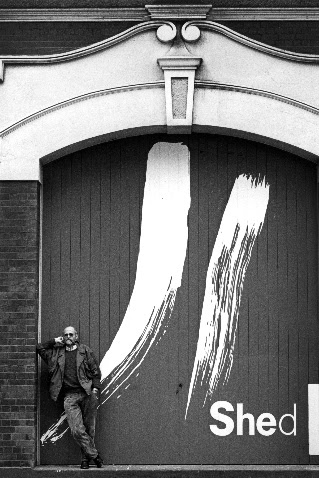
| Luit outside Shed 11, from a post by Catherine Griffiths |
![]() |
| Photo snapped in Luit's archives last year |
By the time I got to know Luit well, he had repurposed himself as a film-maker, working alongside his wife Jan. They produced documentaries on Ans Westra, the Tovey generation of art education, Peter McLeavey, and most recently Theo Schoon. We were lucky enough to be at the premiere of Signed, Theo Schoon last year, and join Jan and Luit afterwards, with all their friends. Ans was there. Luit bantered at her for not paying attention during his speech. It was wonderful.
Over the past two years I've had a few chances to talk to Luit a bit about his career (not very interested in talking about that) and way of working and making films (much more interested). He loved every aspect of it: the relationships (as exasperating as they might be at times), the arguments, the storytelling, the documentation, the romance of the archive, visual punch, emotional heft, the precious, precious stories of people's lives.
Luit, of course, was a vocal opponent of the dissolving of the National Art Gallery in the creation of Te Papa in the 1990s, and a staunch critic of the way Te Papa has collected, shown and served art since opening. At the same time, he could critique because he showed up; he was a frequent user and annotator of those archives; and a friend and encouragement to staff. He was a critic, because he cared deeply and he had strong opinions. Would that we all had that kind of passion.
Luit Bieringa. He was just a really cool cat. He and Jan have always been incredibly kind to me, first with my first husband, William, and now with Reuben. When I moved to Tory St Luit became part of my neighbourhood, and I'd bump into him often at the lights on the corner or at breakfast at Prefab. This part of Wellington will be quieter without him. While his death does not come as a shock, we all have to get used to this new gap in our environment, that space that will gradually heal over into memory.![]() |
| Jan and Luit in the 1960s, from an Instagram post shared today by Stuart McKenzie |
This past week I attended the CAM-D (Council of Australasian Museum Directors) and AMAGA (Australian Museums and Art Galleries Association)* meetings in Perth, also a chance to see the new WA Museum Boola Bardip and the first time I've left Aotearoa since 2019.
It felt like waking up. Like a big lungful of fresh air. Thinking at scale again, meeting new people again, get out of the usual conversational grooves and organisational concerns we all tend to slip into, but have stayed in longer over the past two years of the pandemic.
One of the many things I realised while I was away is that I miss writing. I write so much in my day job that since joining Te Papa, I've barely put any thoughts down outside the course of my work. It's time to ease back in.
So, as a baby-step, here's a round-up of things that I read throughout the week (conference related, and just chronologically aligned).
Mike Dickison linked to two articles this week that I found really interesting:
University of York archaeology lecturer Colleen Morgan's The Outrage Machine, about dealing with the Daily Mail publishing an "outrage-bait" article about her (and others') use of content warnings in their course materials. Morgan's strategy basically boils down to "don't feed the trolls". She notes:
As an academic you really want to set the record straight, to potentially educate the journalist, or perhaps the public, but it doesn’t work that way. With outrage bait articles they are not looking for a reasoned response. They don’t want you to convince them, they want you to be the dumb woke academic mollycoddling our fragile students. They want column inches and maybe a photo of you for their right wing audience to mock. Give them nothing. I’m writing this during the furore, but will likely post it only after things have died down.
Oxford University Museum of Natural History curator Mark Carnell on How and why to cite museums specimens in research. In this post, Carnell describes how poor or overlooked citations of museum collection material create more work, don't show the value of museum collections to research, and amount to trash science:
For many natural history museums, although we work with a range of audiences, scientific publications using our specimens is one of our key measures of success, justifying our staff and existence to local, national and international funding bodies. We’re ecstatic when publications using the collection come out because it’s one of the reasons we are there in the first place. We’re actively keen to promote your research on our collections to our audiences through exhibitions, online and social media. All we ask for in return (and often this is on one of those forms you sign) is that you let us know when you publish, give us a copy of the paper or book and cite the specimens properly.
Somebody at the conference linked to Elizabeth Merritt's (Center for the Future of Museums) latest post In Praise of Mission Creep. In it she notes that the phrase "mission creep" originated in military operations, and that sometimes carrying language over without scrutinising the underlying thinking and context (most of us are not literally running aggressive, politically-charged, life-or-death operations) can be unhelpful, inappropriate, or make our thinking lazy:
Looked at from a different perspective, “mission creep” is often a side effect of the mission itself. This happens, for example, when missions create artificially narrow constraints by focusing on the mechanisms of the work (collect, preserve, interpret) rather than on the change an organization wants to make in the world.
As a relief from all those quite long articles, here's a tweet from the conference by Michael Parry that summarises a concept we need to communicate better about our sector:
Loving this history of the @EgyptianMuseumC another reminder that all museums go through these long cycles of building, rebuilding and redefinition. We may think of them as "permanent institutions" but really it just depends on your timeframe of reference. #AMaGA2022
— Michael Parry (@vaguelym) June 16, 2022
One of the talks I missed was by ACMI's Lucie Paterson and researcher Indigo Holcombe-James; luckily ACMI has long (under Seb Chan's leadership, in a way many of us did in the (g)olden days but few of us - including me - still do): How to increase your museum's digital literacy.
I'm putting this tweet here simply because I know I'm going to want this as a metaphor for so many things in future
Crested mynas, as many other birds, are born altricially, which means young are underdeveloped at the time of birth, therefore fed by parents. When they grow up, they have to learn that food doesn't simply jump into their beaks [📽️: Rebecca Gelernter] pic.twitter.com/xhH1TouIwd
— Massimo (@Rainmaker1973) June 11, 2022
Tristram Hunt at the V&A in London is one of the few museum directors (in English, anyway) who blogs frequently and with a argument (rather than anodyne statements that do not court controversy). I respect him for putting his arguments out there. His posts often leave me feeling unsettled - often professionally grumpy, if I'm honest, with a tendency to write them off as pleas for a status quo and assumption of privilege that I think Western museums should be recognising, reconciling and reinventing for an equitable future.
His latest post, The Enlightenment and the Universal Museum leaves me wondering - as I so often do with his writing - whether I'm just being chippy in seeing it as an exercise in yes-but-still-ism. In it he accepts that the Enlightenment (and the museums that emerged from it) was a beautiful dream based on racism and sexism. He writes:
the challenge for museum leadership is to unpick such toxic legacies and then seek to re-imagine the mission of the Enlightenment as an egalitarian, empowering, and transformative project.
He then writes that the museum needs be a 'cultural and psychological resource' to help individuals 'transcend inherited identities'. That in order to retain trust, the opening of authority in museum collections and interpretation to previously excluded communities and experts must be 'additive to the essential role of museum curation by experts in the field'. He concludes:
Finally, we need to move from the Universal Museum of the Enlightenment to the Cosmopolitan Museum of the 21st century. The racism of the Enlightenment needs to be replaced by a much richer understanding of how the construction of European identity was always a global endeavour. This necessitates a continued reckoning with the imperial and colonial past and, with it, new strategies around restitution and repatriation based on reciprocity, humility, and shared professional endeavour with colleagues in the Global South. The post-war hierarchies must be dismantled to shape a truly cosmopolitan public sphere.
That is the modern calling of the Enlightenment – which endowed so many superb cultural institutions that have, in turn, transformed so many lives over the years. It still matters.
I don't know. I'm getting a weaselly feel off the phrase "Cosmopolitan Museum". I recently (I wish I could remember where) saw someone refer to cosmopolitanism (celebrating immigration, diversity, complex histories) as a possible alternative to biculturalism. Becoming cosmopolitan does not feel to me like decolonising, or deep-reaching re-purposing and reinvention. It feels like a more acceptable face on an old idea. I'm going to have to mull this one.
*No-one knows how to pronounce either of these acronyms. That was one of my favourite parts of the trip.
Britain Thinks for Museums Association, Public perceptions of - and attitudes to - the purposes of museums in society, 2013 [referenced in talk]
Nina Simon, Seeking clarity about the complementary nature of social work and the arts, 2013
Courtney Johnston, Museums and social work: a year of changing thinking, 2014
Dr fari nzinga, Public trust and art museums, The Incluseum, 2016
American Alliance of Museums, Museums and trust, 2021 [referenced in talk]
Western Australian Museum, Value of museums demonstrated during Covid-19, 2021Edelman Trust Barometer 2022
Stuff's charter: A brave new era for NZ's largest media company, Stuff, 2020
Te Manu Korihi, Stuff apologies for its coverage of Māori issues, RNZ, 2020
MediaWatch for 19 December 2021, RNZ, 2021 (featuring Hal Crawford, see below)
Anna Fifield, When did our public servants get so arrogant, Stuff, 2022
Andrew Ecclestone and Simon Wright, How the media can improve the toxic dynamic with government, Stuff, 2022