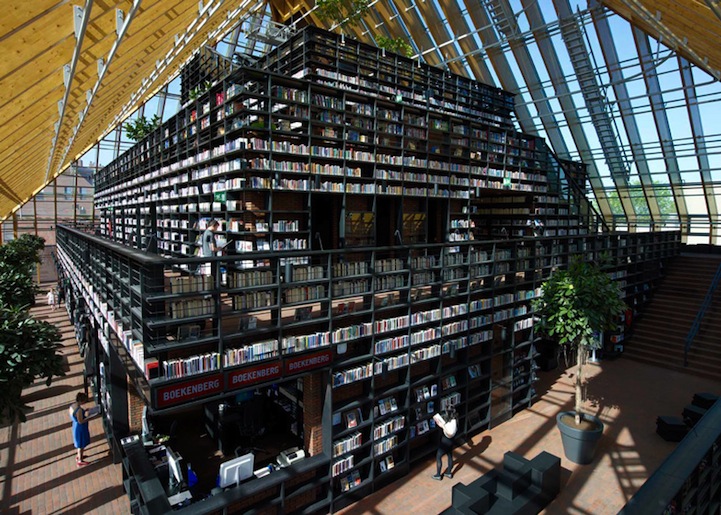
What if an art gallery was designed to show its collection on the outside, like this library?
'Book Mountain' , a new public library, located in Spijkenisse near Rotterdam
The Book Mountain public library, designed by architecture firm MVRDV, is located in the Dutch suburb of Spijkenisse near Rotterdam, a community with an illiteracy rate of 10%. Designed to act as an 'advertisement for reading', the structure consists of five stories of book-walls, encased in a glass structure; it is part of a mixed-use development of housing and commercial areas. (The bookshelves, rather wonderfully and improbably, are made of recycled flowerpots.)
What about sun damage? Apparently, the average life of a library book is 4 years; long term care is not an issue here. So, sure. It might not work for oils and watercolours. But it's a hell of a statement - both visually, and as a distillation of what you do and what you are.
Start your week off by taking in this opinion piece by Camille Paglia in the Wall Street Journal, decrying art student's contempt of capitalism and the beautiful design but ultimate soullessness of the iPhone, and calling for a 'revalorization of the trades'. (Also: "No major figure of profound influence has emerged in painting or sculpture since the waning of Pop Art and the birth of Minimalism in the early 1970s.")
These two videos made me really happy. Beastie Boys! Guerilla art action! Shaun Gladwell! (Though I'm gonna be honest and say the first iteration did delight me more)
MCA Tribute at the MCA from James Beswick on Vimeo.
This is awful, of course. Awful. But what fascinates me is that the first reporting and analysis is happening through Twitter and blogs. A visitor tweeted a picture from the gallery after watching the tagging:
The photo of the tag is now the image for the second result when I google 'Rothko Tate':
This is kind of amazing to me. There is utterly no way for the Tate to 'manage' this story (and as of right now, no-one is updating their Twitter account with details). It's happening in real life and real time. There's no chance for emergency meetings and agreeing on a message - pretty much everything that's there to be known is known and already public.
Another aspect of this that interests me is the long term implications. When this incident enters the long, long history of defaced artworks in public galleries, it will come with a flood of documentation; eye witness accounts, immediate and more considered reports, analysis and speculation - perhaps even statements from the perp. A history of this act of vandalism could start being written tonight (a day is a loooooooong time on Twitter).
None of this academic interest lessens the sense of grief I felt when I saw that scrawled message though. It's such a shitty and senseless thing to do. And as Hari Kunzru pointed out:
The half-day events are free but numbers are limited, so you'll want to get in early. From the NDF website:
Barcamps (sometimes called unconferences) are participant-driven events where the attendees both create the agenda and run the sessions. These NDF barcamps are an opportunity to get together with others in your region and share ideas about the digital work of museums, libraries, archives, galleries and others in the broad cultural heritage space.
These barcamps are free half-day events, being run the month before NDF conference in Wellington. So it's also an opportunity to start a conversation to continue at the conference… or get a taste of NDF and contribute locally if you can't make it to the full conference.
Today on the radio I'll be talking about the Len Lye Centre in New Plymouth getting its funding, Gustav Klimt’s last studio being reconstituted in Vienna, and Rob Cherry, Joe Sheehan and Peter Trevelyan shows at Pataka in Porirua.
Peter Trevelyan, Profiles, (I think), currently on display at Pataka.
I was reminded looking at Trevelyan's four small wall-based sculptures at Pataka (you can see two of these above) of Isaac Gilseman's lovely drawing of the profile of Cape Foulwind
Isaac Gilsemans, Thus appears the main land to south of the Rocky Point [Cape Foulwind] when you sail along the coast and views of the Rocky Point..., 1642. Alexander Turnbull Library.
Born in Christchurch in 1908 (the elder of twin boys - his brother Paul would grow up to become an important architect) from his early 20s Pascoe was a keen mountaineer (and a less-than-keen clerk in his family's law firm). He discovered a talent for photography when he began making records of routes and tracks using a camera.
In the 1930s Pascoe moved to Wellington. In 1937 he wrote to Joe Heenan, under-secretary at the Department of Internal Affairs looking for work. Heenan eventually made him the illustrations editor for the 30-part Centennial series Making New Zealand. In 1942 Heenan appointed Pascoe as an official war artist, and he travelled the country documenting New Zealanders' wartime life.
Pascoe had a long career with DIA, as well as publishing as a photographer and writer in his own right, including being the founding secretary of the Historic Places Trust and as chief archivist at the National Archives. Pascoe was still in this role when he died in Christchurch in 1972.
John Pascoe, Laurie Walker and horse, Manuka Point Station, 1943. Alexander Turnbull Library
But if I was going to pick one photo - just the one - to transport myself into, it might be this scene at Easy Bay, Arapawa Island, one of a number of photos associated with mail launches that I find deeply appealing.
John Pascoe, Jetty at East Bay, Arapawa Island, c.1945. Alexander Turnbull Library.
Help me remember this how once the dead were locked
out of the ground and wandered sleepless and sun-blinded
She was the one who took them each by the hand helped them
lay their bodies back in the dark sweet decay
gladly as onto a lover’s bed they call her Koré
the Maiden a dark queen with a crown of blood-colored poppies
her fingers lift the cool coins from a dead girl’s eyelids
her breath in a man’s mouth releases him from memory
There was a man who would play fast and loose with Love
She smiled at first to hear him tossing around her nicknames
like cheap wedding confetti Pretty Butt Manslayer Smile-lover
or mocking the blessed valentine folded up in her lap
petal-pink as a seashell but when he swore he’d never
let Love knock the wind out of him and leave him panting
that set her teeth on edge Love is a cruel justice
she makes us pay for our lover’s sins as well as our own
and she took away the one whose loss would hurt him deepest
Maybe he would have wept but grim determination
came to him more easily than tears and so he followed
the road that only the desperate walk with their eyes open
where the willows bend to comb their fingers through the river
and the long grass cuts the ankles stalks of mullein
stand like tall candles the dead mixed with the living
and spiders weave webs between them glint in the sunlight
the vague gray country where all shadows gather
and the dark queen keeps them safe in her lightless mansion
She was sitting out on her porch peeling a pomegranate
leaning back in her chair feet propped on the railing
her face a cool and cloudless moon ink-black hair
Who are you she called most of my visitors come here
with their arms crossed and pennies laid over their eyes
My eyes are open he answered nothing I do can close them
night after night I lie awake counting my heartbeats
my hands won’t work they can’t seem to hold anything
Come in the house then she held the door half-open
and deep in the dark hallway he thought he could see the faintest
flutter of movement and he was afraid She took his hand
her fingers cool as a cave of water-hollowed limestone
Someone you knew she asked this graceful tender of shadows
My advice to you is to go home and grieve her
Sound the well of your tears as deeply as you can
wipe your eyes and be glad you’re still among the living
Why he demanded you could bring her back in a heartbeat
Maybe she said do you think you’re the first to come here
chasing after someone they lost but you have the guilty
look of a man who tossed away what he loved too lightly
How can I feel sorry for you You don’t know the first
thing about my love he snapped So prove it she said
sing me a love song who is this girl you miss so much
that you come to my house to fetch her out of the shadows
He sang of the first permission of flesh and flesh to entangle
how we abandon the guard of our heart and throw our borders
open and welcome a sweet invader to take possession
the sudden exquisite catch in a throat and the slow hush
of a breath unfettered the sweetest sounds to a lover’s ear
He sang of hands finding shyly at first their way
to another shelf of hips oh how the heart flares
and melts like wax spilling over a candle’s lip
Even the spiders stopped spinning their webs to listen
I like your song she said maybe you’ll come back
and sing it again for me before too long he shivered
Out of her lawn she plucked a withered stem of mullein
Take this and go home and you’ll find her waiting
I’ll give you one more day and night and the morning after
to spend together however you please I warn you though
when the time comes say your goodbyes and don’t look back
That day the cherry-trees in the square had just flowered
making a roof of white blossom over their heads
That day they walked with the awkwardness of the long parted
and sat on either side of a table and shared a pizza
and washed it down with a half-carafe of cheap red wine
and tried to talk their way back into their bodies
and as they left the leaf-buds were a green promise
and when she stopped to put on more lipstick
she’d left it all printed around the rim of her glass
he laughed and said There goes my chance to kiss you
Why she replied would you ever let that stop you
And they took each other’s lips frankly took their faces
between each other’s hands and the tears were shaken out
like raindrops beaded on a branch and they were barely
able to have enough of touching and they kissed each other dry
and over breakfast they smiled so hard that it hurt
They went to make the bed and found the sheets bloody
and so they fished through all their pockets for quarters and walked
down to the corner laundromat where they sat together
holding hands as they waited and watched the dryer tumble
Together they folded linen billowed it out between them
to shake away the wrinkles brought the corners together
in halves in quarters their bodies coming at each fold closer
and smiling at each other over the hot cotton
The clock-hand spun in circles and soon morning was over
and all they had left was the long drive to the airport
the slow walk through the terminal trying to talk each other
out of sorrow their voices bright with desperation
until they stood at the edge of what any words could comfort
Don’t try to follow me this time she said whatever
else happens we made each other happy for a day
Yes he agreed and they turned to walk away from each other
and though he struggled bravely to keep his face together
he cracked he ran tear-broken back through the concourse
and caught her up in his arms until she eased gently
out of his clasp and kissed him one last time and left him
But too late the moment he turned a demon of memory
sat hard on his shoulder and caught hold of his ear
murmuring over and over the words of their final parting
What what would’ve given the story a happier ending
Out in the meadow that day dark purple butterflies
sipped the sweet nectar from yellow cups of blossom
and blundered into the webs where the big spiders waited
to tuck them into the soft silk of their winding sheets
all their legs a wiggle of happy anticipation
What are you doing here she asked him not unkindly
You look awful your eyes are spilling over with memory
The world hurts to look at he said all glitter and sharp edges
I’m sorry she said but didn’t I warn you to take your time
together and let it go at that it would’ve been kinder
Instead you sent your love back to my mansion loaded
with twice the grief she left with her own and yours also
And with that he felt like he’d fallen into a dark lake
and the cold had got his bones and he was slipping under
Let me join her then he said I’m sick of living
No she told him twice you’ve come here uninvited
and before I let you lay yourself in my bed forever
go back to the sunlit world and tell your story
All I can offer you if you aren’t afraid to accept it
is a kind of consolation and then she gave him a look
that was almost shy First would you do me a small favor
Make me another song like the last one you sang me
only this time sing to me of self-effacing
surrender of love that we give knowing we have to lose it
And so he sang of the love that is not so fearful of ending
that fear ends it love that admits the flavor of pain
the pulling apart of ivy-tendrils ripped from a tree
love that lays itself in the grave of another body
sweetened by loss as we lose ourselves in our lover’s arms
given completely over to pleasure the dark flower
that opens petal by petal unfolding us to the utmost
pitch of surrender lost in the joy of self-forgetting
Then he praised the maiden who makes us a gift of grieving
to spill the bowl of our tears when it grows too heavy
the grace to release our beloved kindly into her care
and not to fear the soft tap of her footsteps approaching
her fingers touching our eyelids when she comes to invite us
into her bed and with cool unhurried hands unravels
the milky threads of our thoughts and memories may we part with them
gladly and go more easily into the dark flower
And the girl smiled as if they’d shared a secret
and she broke the mullein-stalk in half and then in quarters
pressed the pieces into his palm and closed his fingers
Throw these to the wind she commanded and he did
and they were lost in the long grass that cuts the ankles
Then she reached on her tiptoes he was a head taller
and breathed into his mouth the scent of mint and violets
And he woke up alone in the other world and he was
walking down a familiar street and it had been raining
all night and the boughs of the trees were black and heavy
and the first cars of the morning passed with their tires hissing
over the blacktop and under his feet he felt the pavement
slither a carpet of petals battered down by the raindrops
and each puddle swirled with a slick of green-gold pollen
and though he couldn’t remember how or when it happened
his heart had been spilled and at its quick was planted a wet
seed that he’d never known before and it was spring
From the occasional reviews department; two collections of poems by Raymond Carver.
>>>>>>
Ultramarine
So, I don't think Raymond Carver is a very good poet. That didn't stop me from being very taken with a number of these works (and more so by others I found online, scavenging around, and even more so with the next collection, which I skimmed on the walk back from the library to work, becoming an obstacle for pedestrians and a hazard for drivers as I lost myself to the words and pulled away from my surroundings).
I love these poems less for their rhythm and lyricism, more for the small observation, the occasionally cruel honesty. Some felt more like dreams and thoughts and experiences jotted down than poems: 'Mother'
My mother calls to wish me a Merry Christmas.
And to tell me if this snow keeps on
she intends to kill herself. I want to say
I'm not myself this morning, please
give me a break. I may have to borrow a psychiatrist
again. The one who always asks me the most fertile
of questions. "But what are you really feeling?"
Instead, I tell her one of our skylights
has a leak. While I'm talking, the snow is
melting onto the couch. I say I've switched to All-Bran
so there's no need to worry any longer
about me getting cancer, and her money coming to an end.
She hears me out. Then informs me
she's leavingthis goddamn place. Somehow. The only time
she wants to see it, or me again, is from her coffin.
Suddenly, I ask if she remembers the time Dad
was dead drunk and bobbed the tail of the Labrador pup.
I go on like this for a while, talking about
those days. She listens, waiting her turn.
It continues to snow. It snows and snows
as I hang on the phone. The trees and rooftops
are covered with it. How can I talk about this?
How can I possibly explain what I am feeling?
Some feel like even more extreme distillations of Carver's short stories, already lean themselves, but broken with enjambments (not even all that precisely or elegantly - almost like any old person breaking up a short piece of writing so it makes a 'poem'). 'The Jungle' is one of these works - but the last two lines saved it for me:
"I only have two hands,"
the beautiful flight attendant
says. She continues
up the aisle with her tray and
out of his life forever,
he thinks. Off to his left,
far below, some lights
from a village high
on a hill in the jungle.
So many impossible things
have happened,
he isn't surprised when she
returns to sit in the
empty seat across from his.
"Are you getting off
in Rio, or going on to Buenos Aires?"
Once more she exposes
her beautiful hands.
The heavy silver rings that hold
her fingers, the gold bracelet
encircling her wrist.
They are somewhere in the air
over the steaming Mato Grosso.
It is very late.
He goes on considering her hands.
Looking at her clasped fingers.
It's months afterwards, and
hard to talk about.
'Nyquil' has a passage in it that struck me hard and true:
Call it iron discipline. But for months
I never took my first drink
before eleven P.M. Not so bad,
considering. This was in the beginning
phase of things. I knew a man
whose drink of choice was Listerine.
He was coming down off Scotch.
He bought Listerine by the case,
and drank it by the case. The back seat
of his car was piled high with dead soldiers.
Those empty bottles of Listerine
gleaming in his scalding back seat!
The sight of it sent me home soul-searching.
I did that once or twice. Everybody does.
Go way down inside and look around.
I spent hours there, but
didn't meet anyone, or see anything
of interest. I came back to the here and now,
and put on my slippers. Fixed
myself a nice glass of NyQuil.
Dragged a chair over to the window.
Where I watched a pale moon struggle to rise
over Cupertino, California.
I waited through hours of darkness with NyQuil.
And the, sweet Jesus! the first sliver
of light.
The sight of it sent me home soul-searching. I did that once or twice. Everybody does. Go way down inside and look around. I spent hours there, but didn't meet anyone, or see anything of interest. Yes. That.
There is some sweetness, some lightness. Some fancy. 'The Minuet'
Bright mornings.
Days when I want so much I want nothing.
Just this life, and no more. Still,
I hope no one comes along.
But if someone does, I hope it’s her.
The one with the little diamond stars
at the toes of her shoes.
The girl I saw dance the minuet.
That antique dance.
The minuet. She danced that
the way it should be danced.
And the way she wanted.
There is also a lot of fishing. A LOT OF FISHING. And I am good with that - but Brautigan and Bishop already own fishing for me. After a while, I started skimming those ones. Death and fishing. I feel ya.
This though is my favourite in the collection. Pierre Bonnard painted his wife Marthe over and over again in the decades of their marriage, in his luminous light and colour-soaked canvases. Marthe aged with the years, but not the image of her that Pierre held. 'Bonnard's Nudes' -
His wife. Forty years he painted her.
Again and again. The nude in the last painting
the same young nude as the first. His wife.
As he remembered her young. As she was young.
His wife in her bath. At her dressing table
in front of the mirror. Undressed.
His wife with her hands under her breasts
looking out on the garden.
The sun bestowing warmth and color.
Every living thing in bloom there.
She young and tremulous and most desirable.
When she died, he painted a while longer.
A few landscapes. Then died.
And was put down next to her.
His young wife.
>>>>>>>
A New Path to the Waterfall
So, I still don't think Raymond Carver is a very good poet. That didn't stop me from loving some of the short-storiest of the works in this collection. 'What the Doctor Said' is deservedly well-known, for making universal one of those tragic, tragi-comic moments:
He said it doesn't look good
he said it looks bad in fact real bad
he said I counted thirty-two of them on one lung before
I quit counting them
I said I'm glad I wouldn't want to know
about any more being there than that
he said are you a religious man do you kneel down
in forest groves and let yourself ask for help
when you come to a waterfall
mist blowing against your face and arms
do you stop and ask for understanding at those moments
I said not yet but I intend to start today
he said I'm real sorry he said
I wish I had some other kind of news to give you
I said Amen and he said something else
I didn't catch and not knowing what else to do
and not wanting him to have to repeat it
and me to have to fully digest it
I just looked at him
for a minute and he looked back it was then
I jumped up and shook hands with this man who'd just given me
something no one else on earth had ever given me
I may have even thanked him habit being so strong
'Margo' is slight, but moves me
His name was Tug. Hers, Margo.
Until people, seeing what was happening,
began calling her Cargo.
Tug and Cargo. He had drive,
they said. Lots of hair on his face
and arms. A big guy. Commanding
voice. She was more laid-back. A blonde.
Dreamy. (Sweet and dreamy). She broke
loose, finally. Sailed away
under her own power. Went to places
pictured in books, and some
not in any book, or even on the map.
Places she, being a girl, and cargo,
never dreamed of getting to.
Not on her own, anyway.
I think it is not the 'being a girl', but that notion of venturing forth, unexpectedly, under your own power, and finding you can navigate with deftness and travel distances that you - and others - did not explicitly rule out, but never thought should be ruled in.
A New Path to the Waterfall was published the year after Carver's death. In her introduction, Gallagher talks about working with Carver to bring together this last book. Gallagher writes at length about the structure of the book, and the introductions of poemised extracts of texts by Chekov (I - a nonwriter - am not going to argue with two writers about the decision. But I didn't get much out of it.). As well as the professional, she writes of the personal. Of how in 'Summer Fog' Carver told her he was trying to do for her what she would do for him, and he would never do - mourn her. Of how on a last fishing trip to Alaska, where they spent mornings working on the manuscript and afternoons with their friends, when they came to the end of the work Carver asked her to pretend they had not, so they could keep these mornings of theirs. Of the piece of scrap paper next to Carver's typewriter, on which he had written "Forgive me if I am thrilled with the idea, but just now I thought that every poem I write ought to be called 'Happiness'."
In her final pages, Gallagher protests to those who may feel Carver wasted his time on poetry - short, precious time better spent on fiction. 'But this would be to miss', she writes, 'the gift of freshness his poems offer in a passionless era.' The passion, the intimacy, the gratitude rise off this collection like steam off a hot bath in cold night air - 'Gravy' (Gravy, these past ten years. / Alive, sober, working, loving and / being loved by a good woman.), 'Woman Bathing' (We laugh at nothing / and as I touch your breasts / even the ground-squirrels / are dazzled'). And oh - the poem of the book (of his career) for me will have to be 'Hummingbird (for Tess)'
Suppose I say summer,
write the word “hummingbird,”
put it in an envelope,
take it down the hill
to the box. When you open
my letter you will recall
those days and how much,
just how much I love you.
That little ritual of love is so sweet, so clear. Even as an imagined (Suppose ...) act, the sweet gift is there. You, it says. Oh, you. You who know what power one word holds, shared between lovers. You who make each day summer.
I can't find many traces of Betham online - he is a very recent grad from Massey, and his work, according to Enjoy's website, 'explores notions of spiritual enlightenment and the absurd methodologies used in the attempt to attain it.'
What Would I Do Without You? consists of three video works, a photograph with a bucket of tennis balls beneath it, and a central installation of a tumble of white plastic deck chairs - ubiquichairs, you could call them. These chairs crop up in the video works too - in one, they are hauled out of a swimming pool; in another, they are hooked by their feet onto a cyclone wire fence, then persistently shaken and shrugged off by unseen forces. The third video work is a black screen, occasionally punctuated by a white chair flying into and falling from sight, accompanied by heavy breathing and hefty grunts.
Daniel Betham, a video work, What Would I Do Without You?
Daniel Betham, the installation work, What Would I Do Without You?
Daniel Betham, the photograph, What Would I Do Without You?
Again according to the exhibition handout, Betham uses video to
explore contemporary notions of spirituality and nihilism in a poetic and absurd fashion.
The films rehearse contemporary rituals or ad hoc games performed in sporting arenas. These games are original attempts at spontaneous questing – for the moment of fulfillment – in a post-nihilist or neo-transcendental manner.
By performing the games in sporting arenas, Betham draws our attention to the absurd nature of game playing and highlights its useless, yet also necessary, role as a platform for nourishing our sense of self-fulfillment: we create our own parameters, rules and games and gain a sense of achievement from their completion.
Betham addresses the parallels between the rhetoric in advertising for sporting brands such as Nike’s Just Do It campaign, and that of spiritual and motivational media, such as the Oprah-endorsed The Power of Now by Eckhart Tolle.
Both mediums make use of transcendental philosophies in their promotional campaigns. Using routines of relentless self-induced optimism, they suggest infinite possibilities for intangible rewards. The shoes and the book that you buy are the peripheral products; you are really purchasing the belief that there is a better you out there, one that is yet to be attained.
I always find it interesting to test my understanding on an artist I know nothing about. My reading of the works was that they documented challenges and tests with self-constructed, internally logical rules and instructions that had to be followed; the videos of the chairs being shaken from the fence and the chair being flung into the air were easy to read in this way. The tennis balls and green-clothed chair I assumed were the documentary remains of a similar undertaking, just as the Nude Descending a Staircase-like installation was a further reworking of the materials used in the making of the video pieces.
What really struck me though was the polish and consistency of the works and their presentation. The video works - the pool work in particular (I can't find individual titles for the works, so this is as good as it's going to get, I'm afraid) - are really quite beautiful, and arresting; you want to follow them. The photograph and the bucket of balls are more puzzling (OH while standing on the landing: Dad, why tennis balls? Because it's art.), bu the installation gives the show a strong core and something for all the other pieces to gather around.
It feels condescending to say 'I was impressed', but I was. It reminded me of seeing Daniel du Bern's 2006 exhibition at the Hirschfeld Gallery - that same sense of a new artist who had really thought through their work (du Bern was more idiosyncratic and personalised - Betham feels more refined). The exhibition finishes on Saturday 29 September, leaving you plenty of time (well, if you're a Wellingtonian) to get down there.
*After a couple of dodgy experiences, on Saturday the Parekowhai was back to its miraculous best. The friend I took - someone who admits he finds going to art galleries somewhat intimidating - was as moved as I. There is a paper I want to present, somewhere, sometime, about the changes this work underwent during its month at Te Papa.
Peter Robinson Boy Am I Scarred Eh, 1997. Oilstick and acrylic on unstretched canvas. 2145 x x1750cm. Image from the Art+Object website.
The purchase of the Robinson of course complements the two works from McCahon's Scared series that Te Papa has purchased in recent years: Mondrian's Last Chrysanthemum(1976) and Scared (1976).
The two McCahons are currently on show on Level 5 at Te Papa, in a short term exhibition alongside Michael Parekowhai and Jim Allen. The exhibitions end on Sunday; I can't recommend enough that you make a visit part of your weekend. And I can't hope enough that we get to see the Robinson out on the floor soon.