[Republished, because I mucked up some HTML]
Back in the day, when I was one of the people running the National Library's twitter account, we used to agonise regularly about whether our linking lines were too smutty, or that the material we were linking to was too off-colour. It's surprisingly difficult to have a sense of humour when you're inside an institution, speaking out.
So I guess it's up to the people on the outside to have the good, smutty fun. Three examples that have come across the transom lately:
Fuck Yeah Victorians: clippings of all things Victorian gleaned from around the web.
Bangable dudes in history: it's not exploitation if there's pie-charts.
And my personal favourite, My daguerreotype boyfriend: because any hot guy looks better in long exposure. Especially, for some reason, criminals.
Showing posts with label twitter. Show all posts
Showing posts with label twitter. Show all posts
Monday, 13 June 2011

Thursday, 17 March 2011
Social media, museums & artlovers
If you're an early riser, you might like to participate in a live Twitter session tomorrow morning (6am New Zealand time), organised by the New York Times and featuring the following luminaries:
The hashtag is #nytmuseums. If, like me, you're unlikely to be glued to the screen at 6am, you'll be able to recap the conversation in this chat room.
- Shelley Bernstein, Brooklyn Museum @shell7
- Rob Stein, Indianapolis Museum of Art @rjstein
- Ian Padgham, San Francisco Museum of Modern Art @origiful
- Erin Coburn, Metropolitan Museum of Art @metmuseum
The hashtag is #nytmuseums. If, like me, you're unlikely to be glued to the screen at 6am, you'll be able to recap the conversation in this chat room.
Monday, 7 March 2011
Making it real
I remain fascinated by digital things that are re-released into the world as physical objects.

Over the weekend on the New Yorker site, Ian Crouch blogged about Tweets from Tahrir, an edited collection of tweets from the popular revolution that overthrew Murabak in Egypt:

I realised when reading this that one of my own tweets has already been collated into a print book. In February 2009 Carl Malamud ran for the position of Public Printer in the States on a platform of open data, and gathered tweets in support of his application into a PDF and printed book. I have a copy of the print book at home. My tweet is on the second page. Malamud didn't become Public Printer, but it was an early intimation for me of what being connected to something big could feel like on Twitter.

Another - rather exquisite - example of this physical/digital, activism-linked trend is James Bridle's print edition of every edit to the Wikipedia page about the Iraq War between December 2004 and September 2009.
Over the weekend on the New Yorker site, Ian Crouch blogged about Tweets from Tahrir, an edited collection of tweets from the popular revolution that overthrew Murabak in Egypt:
Alex Nunns, a British journalist, and Nadia Idle, an Egyptian who was on the ground in Cairo during the protests, began archiving tweets as they were posted, and have been combing through feeds ever since to build a portrait of, as Nunns tweeted in February, a “1st draft [of] history.”Crouch's piece makes some interesting points about how collections like this function in the traditional publishing model, asking whether the publishers are paying the original tweeters (no - the relationship, says the publisher, is with the editors, although the tweeters have been contacted and have given their permission).
Brock Shinen, an intellectual property and entertainment lawyer, has written that tweets could rarely, if ever, be protected, largely because they trade mostly in facts, which do not fall under copyright. So tweets from Cairo, such as “OMG, Mubarak’s thugs are storming the square on camels!,” might provide a thrilling glimpse into events as they were happening, but they are just short communications of observable fact. Even an incisive tweet: “Egypt’s revolution most important since 1989,” likely lacks the originality or creativity to be protected. Yet the content of tweets may not be entirely given over to the world; a ruling last year in the case of a Haitian photographer whose Twitpics had been printed by several news agencies, including Agence France-Presse, without permission or payment rejected AFP’s claim that printing a photograph was the same as retweeting someone’s post. Twitter users may retain certain rights, though it’s unclear as to how generally applicable this case will be.
I realised when reading this that one of my own tweets has already been collated into a print book. In February 2009 Carl Malamud ran for the position of Public Printer in the States on a platform of open data, and gathered tweets in support of his application into a PDF and printed book. I have a copy of the print book at home. My tweet is on the second page. Malamud didn't become Public Printer, but it was an early intimation for me of what being connected to something big could feel like on Twitter.
Another - rather exquisite - example of this physical/digital, activism-linked trend is James Bridle's print edition of every edit to the Wikipedia page about the Iraq War between December 2004 and September 2009.
It amounts to twelve volumes: the size of a single old-style encyclopaedia. It contains arguments over numbers, differences of opinion on relevance and political standpoints, and frequent moments when someone erases the whole thing and just writes “Saddam Hussein was a dickhead”.
This is historiography. This is what culture actually looks like: a process of argument, of dissenting and accreting opinion, of gradual and not always correct codification.
And for the first time in history, we’re building a system that, perhaps only for a brief time but certainly for the moment, is capable of recording every single one of those infinitely valuable pieces of information. Everything should have a history button. We need to talk about historiography, to surface this process, to challenge absolutist narratives of the past, and thus, those of the present and our future.
Thursday, 16 September 2010
Memory and memorials
Yesterday on the radio I talked about how Christchurch's galleries and museums have come through the Canterbury earthquake. Although it's a terrific shame about the damage to the Logie collection at the University of Canterbury, I was greatly relieved to hear how safely the buildings and collections of the Canterbury Museum and Christchurch Art Gallery came through the initial quake and the aftershocks: both have now reopened. It's a true testament to the foresight and skills of their staff.
As I noted in my piece, the Gallery in particular did a fantastic job of keeping its friends and fans up to date via its blog and twitter, and giving us peeks into the surreal sights of a gallery being used as a civil defence headquarters.

As I also noted on the radio, I really hope to see a community archive built around the photos, tweets, blog posts, news items and everything else that's been produced and sent out of Christchurch since last Saturday. There are all sorts of logistics around this, and Twitter is one of the most complicated, both in terms of copyright and the ephemeral nature of a tweet (they start disappearing off the web after about 20 days). While Twitter is lodging their archives with the Library of Congress, that's not going to help us much over here.


It's old school, but I've always dealt with this in the past by taking screenshots. A more sophisticated push to deal with all this stuff might involve using something like the kete software, and combing Flickr and blogs and asking photographers and writers for their permissions to upload copies of their content (a great opportunity to do some Creative Commons promotion and education at the same time). And I really hope that the National Library, which has the mandate to make copies of New Zealand digital content, has been out there collecting madly since last Saturday.
This morning I saw that The Press and stuff.co.nz are 'crowdsourcing' people's earthquake memories. This is a great initiative, but inevitably it comes with the 'all your copyrights are belong to us" terms and conditions:
Sigh. There's got to be a better way.
As I noted in my piece, the Gallery in particular did a fantastic job of keeping its friends and fans up to date via its blog and twitter, and giving us peeks into the surreal sights of a gallery being used as a civil defence headquarters.
As I also noted on the radio, I really hope to see a community archive built around the photos, tweets, blog posts, news items and everything else that's been produced and sent out of Christchurch since last Saturday. There are all sorts of logistics around this, and Twitter is one of the most complicated, both in terms of copyright and the ephemeral nature of a tweet (they start disappearing off the web after about 20 days). While Twitter is lodging their archives with the Library of Congress, that's not going to help us much over here.
It's old school, but I've always dealt with this in the past by taking screenshots. A more sophisticated push to deal with all this stuff might involve using something like the kete software, and combing Flickr and blogs and asking photographers and writers for their permissions to upload copies of their content (a great opportunity to do some Creative Commons promotion and education at the same time). And I really hope that the National Library, which has the mandate to make copies of New Zealand digital content, has been out there collecting madly since last Saturday.
This morning I saw that The Press and stuff.co.nz are 'crowdsourcing' people's earthquake memories. This is a great initiative, but inevitably it comes with the 'all your copyrights are belong to us" terms and conditions:
You grant us a non-exclusive, royalty-free, perpetual, worldwide licence to republish any material you submit to us, without limitation, in any format.
We retain the right and discretion to terminate your access to the comments areas if we believe you are abusing the services in any way, or have breached these terms and conditions.
You consent to our collecting and storing your email and IP address for security purposes.
Sigh. There's got to be a better way.
Wednesday, 8 September 2010
Ask a curator

Last Wednesday was Ask A Curator day on Twitter - the above was the first question I put out (for the record, @ChchArtGallery and @CityGalleryWgtn said Fiona Connor, @WallaceArtTrust wasn't keen to pick, and I didn't hear back from @Fresh274 and @AucklandArtGal didn't reply to any of my questions).
Ask a Curator was run by Sumo, an English company that works a lot in social media with museums and galleries. It followed on from Follow a Museum day, run by Sumo in February this year.
My own experience of Ask A Curator day wasn't that much different from my average day on twitter, although I enjoyed the backchannel chit-chat with @tinks03 and @cherylbernstein as we talked about the event and the answers. But then, I'm lucky, If I have a question for a curator, I can generally drop them an email and expect an answer. Ask A Curator day wasn't really about or for me.
The point of the day was to start new conversations. The following morning I asked a few institutions whether they'd had conversations with new people, or just the usual suspects.


So, can the event be judged a success? It's hard to tell. Because New Zealand started the event early (due to timezones) we missed the spam attack that took place when the hashtag started trending, which was a bonus for us. Do 10 extra international followers equal a success? Maybe, if you keep talking to them (even more I guess if they all jump on a plane and head over here....). 'Success' is a surprisingly difficult question: one of my favourite exchanges of the day occurred when @tinks03 asked
 'Success is a topic I'll be trying to tackle in a panel discussion about social media at the National Digital Forum in Wellington in October - earlybird registration has just been extended until this Friday. I'll be joined on the panel by Renae Mason from the Powerhouse Museum: you can read their account of taking part in Ask a Curator day on their Fresh and Newer blog, and their reasons for hacking the event and using Facebook instead of Twitter.
Other round-ups of the event:
Ema Tavola (Fresh Gallery) and Neil Semple (Christchurch Art Gallery) on the NZMuseums site
An American perspective from Carolina Miranda (aka C-Monster)
Jim Richardson from Sumo (covers the spamming that occurred)
Danny Birchall gives the (professional) participants view
Wednesday, 7 July 2010
Hacking colour fields
Today I started playing with Brooklyn Museum's latest 1st fans artist's project, Tweeting Colors by Brian Piana.
Piana has been using Twitter to generate source material for a while. Ellsworth Kelly Hacked My Twitter, for example, is a dynamic digital artwork modified whenever one of the people Piana's follows on Twitter tweets.* Medals (after Stella) responded to tweets containing specific words related to Olympic medals. [It's probably good to note that Piana bases these titles on visual similairities and his own admiration of the artist's work, rather than claiming a conceptual kinship.]
 Piana's project for 1stFans is somewhat different. In this case, members of 1stfans control the artwork, by tweeting phrases that contain the relevant keywords and hashtags (including a number and a colourcode from the palette Piana has provided).

The tweets are parsed as scrolling vertical lines of colour of various widths.

The interaction is very simple right now, although Piana says he will introduce more functions as July passes. Right now I'm participating with a daily tweet, where the colour is related to the weather (so yeah, lots of greys) and the date provides the number. I'm interested to sees where this leads.
*Don't worry, I do understand that if you haven't succumbed to Twitter, all this is about as meaningful to you as 'discursive frameworks' is to me. Bear with me, and I promise the next post won't been tweety.
Piana has been using Twitter to generate source material for a while. Ellsworth Kelly Hacked My Twitter, for example, is a dynamic digital artwork modified whenever one of the people Piana's follows on Twitter tweets.* Medals (after Stella) responded to tweets containing specific words related to Olympic medals. [It's probably good to note that Piana bases these titles on visual similairities and his own admiration of the artist's work, rather than claiming a conceptual kinship.]
Piana's project for 1stFans is somewhat different. In this case, members of 1stfans control the artwork, by tweeting phrases that contain the relevant keywords and hashtags (including a number and a colourcode from the palette Piana has provided).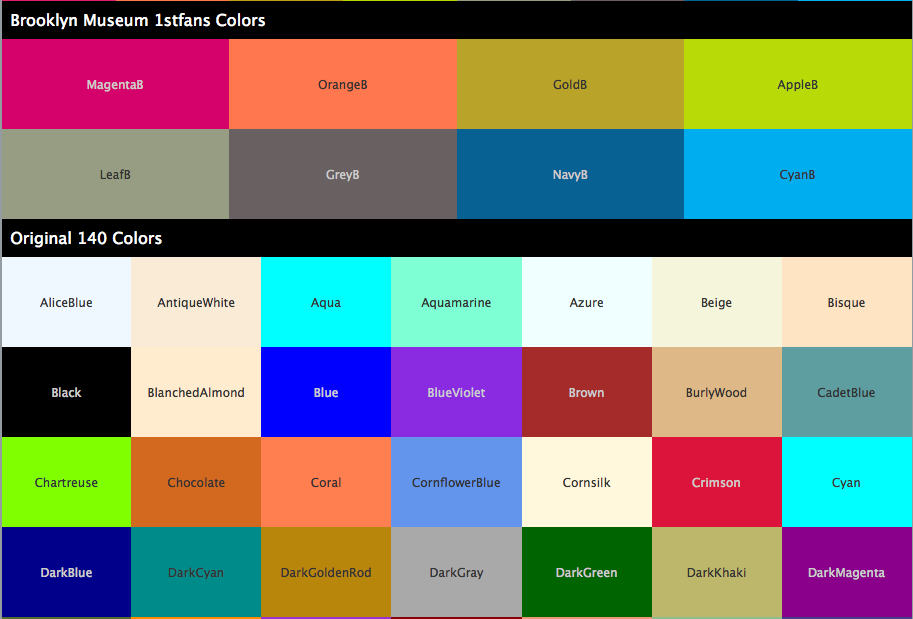
The tweets are parsed as scrolling vertical lines of colour of various widths.

The interaction is very simple right now, although Piana says he will introduce more functions as July passes. Right now I'm participating with a daily tweet, where the colour is related to the weather (so yeah, lots of greys) and the date provides the number. I'm interested to sees where this leads.
*Don't worry, I do understand that if you haven't succumbed to Twitter, all this is about as meaningful to you as 'discursive frameworks' is to me. Bear with me, and I promise the next post won't been tweety.
Monday, 1 February 2010
What people will pay for
When I scrolled through my overnight tweets this morning (yes, this is another Twitter-related post) I saw this, from Will Cary, the membership manager at Brooklyn Museum:

And just now I spotted this, re-tweeted from the Brooklyn Museum account:

The show they're talking about is 'Who Shot Rock and Roll', which closes today in the US (yesterday for us New Zealanders). It's been very popular, and it sounds like lines to get into the show for its final weekend are significant.
One of the benefits of a Brooklyn Museum membership is that you get to bypass the lines. A normal individual membership costs $55. Suggested admission at the Museum is $10 for adults. This weekend, more than six times the normal number of people bought a membership, presumably so they could bypass the lines. I can't see any special promotion of the queue-skipping powers of membership attached to the exhibition promotion on the Museum website, but it's strongly featured on their Twitter feed; lots of people are talking about the show on Twitter as well.
It's tempting to see this as a little parable about what will tip people over from thinking about buying a membership to actually doing it. They're not buying a discount on entry (a normal Friends benefit in New Zealand) - they'e buying something that gives them the advantage of easier access.
Contrast this with City Gallery Wellington's current Yayoi Kusama show. Friends of the Gallery get a 20% discount on the entry charge ($8 instead of $10) but no queue-skipping privileges. There don't appear to be any members-only days or extended hours for Friends - based on the above, I predict that this would have attracted a bunch of new sign-ups, especially if implemented after people had seen the crazy free Wednesday queues. It might be something for galleries hosting blockbusters to look into - after all, sometimes there's nothing nicer than flashing a card and getting waved through ....
And just now I spotted this, re-tweeted from the Brooklyn Museum account:
The show they're talking about is 'Who Shot Rock and Roll', which closes today in the US (yesterday for us New Zealanders). It's been very popular, and it sounds like lines to get into the show for its final weekend are significant.
One of the benefits of a Brooklyn Museum membership is that you get to bypass the lines. A normal individual membership costs $55. Suggested admission at the Museum is $10 for adults. This weekend, more than six times the normal number of people bought a membership, presumably so they could bypass the lines. I can't see any special promotion of the queue-skipping powers of membership attached to the exhibition promotion on the Museum website, but it's strongly featured on their Twitter feed; lots of people are talking about the show on Twitter as well.
It's tempting to see this as a little parable about what will tip people over from thinking about buying a membership to actually doing it. They're not buying a discount on entry (a normal Friends benefit in New Zealand) - they'e buying something that gives them the advantage of easier access.
Contrast this with City Gallery Wellington's current Yayoi Kusama show. Friends of the Gallery get a 20% discount on the entry charge ($8 instead of $10) but no queue-skipping privileges. There don't appear to be any members-only days or extended hours for Friends - based on the above, I predict that this would have attracted a bunch of new sign-ups, especially if implemented after people had seen the crazy free Wednesday queues. It might be something for galleries hosting blockbusters to look into - after all, sometimes there's nothing nicer than flashing a card and getting waved through ....
#followamuseum
Jim Richardson 0f Sumo has dubbed February 1 follow a museum day, in an attempt to draw Twitter users' attention to museums.
The follow a museum site has a useful country-by-country directory of museum Twitter accounts.
Here's what I look for when I'm thinking about following an organisation on Twitter:
A note on hashtags
A hashtag- a # placed in front of a word or acronym in a tweet, such a #followamuseum - is a way of associating messages with a particular theme.
The power of the hashtag is seen particularly in search; following this link will take you to a Twitter search page that dynamically updates as new Twitter messages carrying the #followamuseum tag are posted.
The follow a museum site has a useful country-by-country directory of museum Twitter accounts.
Here's what I look for when I'm thinking about following an organisation on Twitter:
- Is there a named person/people in charge of the Twitter account?
- Is the activity on the account regular, or are there random blips of tweeting?
- Is the activity all around promoting exhibitions and events (which are only really interesting to me if they're in my home town) or is there more behind-the-scenes information?
- Is the stream just made up of announcements and retweets of positive comments, or does it look like people at the museum are actually talking to the people following them (about things other than the museum itself)?
A note on hashtags
A hashtag- a # placed in front of a word or acronym in a tweet, such a #followamuseum - is a way of associating messages with a particular theme.
The power of the hashtag is seen particularly in search; following this link will take you to a Twitter search page that dynamically updates as new Twitter messages carrying the #followamuseum tag are posted.
Thursday, 17 December 2009
Besties II
Best news
The Julian and Josie Robertson promised gift of 15 international artworks to Auckland Art Gallery.
Best new comms tool
Twitter is a top competitor for 2009 word-of-the-year. Christchurch Art Gallery, City Gallery Wellington, Auckland Museum and Te Papa's Collections Online twitter accounts are all run by people who give a damn about their audiences, and that's what makes them work.
Best read
New Zealand doesn't suffer from a lack of writing about art, but we do lack of analysis of the art sector and the way it does (and sometimes doesn't) function. David Marr's The Henson Case was published in October 2008 but as I didn't read it until this year, I'm counting it as 2009's best read: a lucid and considered, but pacey, account of the unfolding of the controversy surrounding Henson's photographs of a naked adolescent.
The Julian and Josie Robertson promised gift of 15 international artworks to Auckland Art Gallery.
Best new comms tool
Twitter is a top competitor for 2009 word-of-the-year. Christchurch Art Gallery, City Gallery Wellington, Auckland Museum and Te Papa's Collections Online twitter accounts are all run by people who give a damn about their audiences, and that's what makes them work.
Best read
New Zealand doesn't suffer from a lack of writing about art, but we do lack of analysis of the art sector and the way it does (and sometimes doesn't) function. David Marr's The Henson Case was published in October 2008 but as I didn't read it until this year, I'm counting it as 2009's best read: a lucid and considered, but pacey, account of the unfolding of the controversy surrounding Henson's photographs of a naked adolescent.
Monday, 1 June 2009
Web muster
Crisis stations everyone. It's the end of art journalism as we know it (András Szántó, Arts Newspaper), perhaps even the end of art book publishing ( Jamie Camplin, Arts Newspaper).
The Smithsonian has gone all wikified for the creation of its Web and New Media strategy process.* I'm still a bit of a wiki sceptic, I'm afraid - mostly because I personally find them a little daunting if they're not part of my daily routine. But I do think its smart the way the homepage suggests different things you can do based on the time you have available. The YouTube channel they've set up is small but worth picking through; here's video that's been uploaded, about - of course - Twitter.
And another wiki initiative, this one from the UK National Archives. On Your Archives people can sign up and start adding to the information known about collection items by expanding catalogue entries, transcribing digitised documents, or providing research guidance.
*Surely one of those business-case words is redundant?
The Smithsonian has gone all wikified for the creation of its Web and New Media strategy process.* I'm still a bit of a wiki sceptic, I'm afraid - mostly because I personally find them a little daunting if they're not part of my daily routine. But I do think its smart the way the homepage suggests different things you can do based on the time you have available. The YouTube channel they've set up is small but worth picking through; here's video that's been uploaded, about - of course - Twitter.
And another wiki initiative, this one from the UK National Archives. On Your Archives people can sign up and start adding to the information known about collection items by expanding catalogue entries, transcribing digitised documents, or providing research guidance.
*Surely one of those business-case words is redundant?
Thursday, 2 April 2009
Semi-critical mass
Twitter has certainly reached the art crowd in NZ, with more institutions and bloggers popping up everyday. Here's a list of some of the people out there (I think I've excluded everyone who locks their feed, as a matter of courtesy)
Over the net
Cheryl Bernstein
Auckland Art Gallery
Christchurch Art Gallery (imminent)
Auckland Museum
RobertMcDougall
And if you're looking to find more ....
My top two Brits
Ben Goldacre
Neil Gaiman
And top three Americans
Tyler Green
Richard McCoy
Brooklyn Museum
Over the net
Cheryl Bernstein
Auckland Art Gallery
Christchurch Art Gallery (imminent)
Auckland Museum
RobertMcDougall
And if you're looking to find more ....
My top two Brits
Ben Goldacre
Neil Gaiman
And top three Americans
Tyler Green
Richard McCoy
Brooklyn Museum
Tuesday, 27 January 2009
Ker-ching
One of the most thought-provoking things I read over the summer break was one of James Surowiecki's regular columns for The New Yorker.
In 'News You Can Lose' Surowiecki looked at the effect withering advertising revenues and the rise of the internet have had on newspapers. He writes:
Surowiecki points out that none of the major news aggregating services - such as Google News - are run by newspaper companies, and that many newspapers have carried over a 'walled garden' approach to their websites, refusing to link out from their articles to other pieces of coverage or other websites.
Meanwhile, bloggers like me are happily piggybacking off the backs of newspapers, using their reportage as the basis for our own writing. (You could see this post as a prime example - at this point, I think it includes more of Surowiecki's text than my own). As he writes at the end of the article:
This got me thinking - what would I pay for?
In the Yes column:
In the No column
Which confirms what Surowiecki is saying: I'm a media free-loader, and currently I enjoy the best of both worlds. I use a news aggregator to pull together bits and pieces from nearly 100 sources, rather than remaining faithful to any one media outlet. And while I feel kinda bad about this, I'm really unwilling to change my behaviour.
BUT. For the past two years I've (well, we've) donated US$20 to NPR to help pay for the bandwidth that brings me the This American Life podcasts. I don't have to, but Ira asks so nicely, and I really value their offerings. So maybe there is hope.
In 'News You Can Lose' Surowiecki looked at the effect withering advertising revenues and the rise of the internet have had on newspapers. He writes:
Newspaper readership has been slowly dropping for decades—as a percentage of the population, newspapers have about half as many subscribers as they did four decades ago—but the Internet helped turn that slow puncture into a blowout. Papers now seem to be the equivalent of the railroads at the start of the twentieth century—a once-great business eclipsed by a new technology. In a famous 1960 article called “Marketing Myopia,” Theodore Levitt held up the railroads as a quintessential example of companies’ inability to adapt to changing circumstances. Levitt argued that a focus on products rather than on customers led the companies to misunderstand their core business. Had the bosses realized that they were in the transportation business, rather than the railroad business, they could have moved into trucking and air transport, rather than letting other companies dominate. By extension, many argue that if newspapers had understood they were in the information business, rather than the print business, they would have adapted more quickly and more successfully to the Net.
Surowiecki points out that none of the major news aggregating services - such as Google News - are run by newspaper companies, and that many newspapers have carried over a 'walled garden' approach to their websites, refusing to link out from their articles to other pieces of coverage or other websites.
Meanwhile, bloggers like me are happily piggybacking off the backs of newspapers, using their reportage as the basis for our own writing. (You could see this post as a prime example - at this point, I think it includes more of Surowiecki's text than my own). As he writes at the end of the article:
For a while now, readers have had the best of both worlds: all the benefits of the old, high-profit regime—intensive reporting, experienced editors, and so on—and the low costs of the new one. But that situation can’t last. Soon enough, we’re going to start getting what we pay for, and we may find out just how little that is.
This got me thinking - what would I pay for?
In the Yes column:
- Google Reader (and possibly Gmail - which would become a lot more important to me if I lost my job)
- Twitter (I'd ditch my cell phone before I lost this)
- Blogger (I'd rather pay Google or Wordpress to use their platforms than pay a viewing fee for all the blogs I visit)
- Ma.gnolia (it's speed drives me crazy, but I'm in their clutches now, with years' worth of carefully annotated websites and articles tucked away there).
In the No column
- Pretty much any newspaper or magazine site. Although I read bits of them often (the Guardian most days, various US papers most weeks, Stuff and the NZ Herald when I can't help it) I'd be really reluctant to subscribe to any of them on a full time basis. I get most of my news from National Radio, and no single publication provides enough articles tailored to my interests to make a daily, weekly or yearly fee worthwhile. Except the New Yorker - and I have a print subscription, because I can't read that much online.
Which confirms what Surowiecki is saying: I'm a media free-loader, and currently I enjoy the best of both worlds. I use a news aggregator to pull together bits and pieces from nearly 100 sources, rather than remaining faithful to any one media outlet. And while I feel kinda bad about this, I'm really unwilling to change my behaviour.
BUT. For the past two years I've (well, we've) donated US$20 to NPR to help pay for the bandwidth that brings me the This American Life podcasts. I don't have to, but Ira asks so nicely, and I really value their offerings. So maybe there is hope.
Wednesday, 14 January 2009
Nay, I say.
Hi there. I'm Best of 3. You might know me for my relentless support of such web phenomena as Flickr and Twitter.
Well, today I'm here to tell you that all the glistens on the web is not gold. There's a lot of hoo-ha on the wires this morning about the partnership between Google Earth and the Prado, which has resulted in 14,000 megapixel digital images of 14 of the Prado's key works being made available for intensely close-up viewing through Google Earth (which you need to download to access, so here's the link to do that).
The resolution of the images is beyond amazing; the white flecks of paint in the eyes of the Infanta in Las Meninas are easily visible, the flicks of apricot paint on the side of her cheek are centimetres long on my screen. But. It's only 14 works from the collection. There's no plan to digitise more at this level, or to work with other museums. I'm not even sure that the images are available on the Prado's own website (it's refusing to load this morning).
While I'm not as hung up as Jonathan Jones on the lack of the silvery light when you see the works in person, I'm going to favour standard digitisation and and easier method of access over extraneously high-quality, extremely limited digitisation every time.
However - the video recording how the images were made and stitched together is amazing. Enjoy (and I recommend on mute).
Well, today I'm here to tell you that all the glistens on the web is not gold. There's a lot of hoo-ha on the wires this morning about the partnership between Google Earth and the Prado, which has resulted in 14,000 megapixel digital images of 14 of the Prado's key works being made available for intensely close-up viewing through Google Earth (which you need to download to access, so here's the link to do that).
The resolution of the images is beyond amazing; the white flecks of paint in the eyes of the Infanta in Las Meninas are easily visible, the flicks of apricot paint on the side of her cheek are centimetres long on my screen. But. It's only 14 works from the collection. There's no plan to digitise more at this level, or to work with other museums. I'm not even sure that the images are available on the Prado's own website (it's refusing to load this morning).
While I'm not as hung up as Jonathan Jones on the lack of the silvery light when you see the works in person, I'm going to favour standard digitisation and and easier method of access over extraneously high-quality, extremely limited digitisation every time.
However - the video recording how the images were made and stitched together is amazing. Enjoy (and I recommend on mute).
Tuesday, 13 January 2009
Four interesting things I have read today
Jen Graves: 'In Art News' Jen Graves of The Stranger (Seattle) takes apart an article bemoaning the departure of the Seattle Times' art critic Sheila Farr. The original article, by Emily White, is one of the now-becoming-familiar condemnations of the lack of respect amongst newspapers for experienced art reviewers. Graves argues:
Penguin Blog: Fav '08 cover designs Members of the Penguin Art Department discuss their favourite book cover designs of the past year in this beautifully illustrated blog post.

The Book Cover Archive Not just a beautiful site to explore, but obviously a well-kept and well-mannered one; a list of proposed and achieved enhancements is listed at the bottom of all the pages, along with links to similar sites.
Nina Simon's message to museums re:Twitter I've been meaning to talk about this here, but have decided to work blog it instead. Many people say that there's no right or wrong way to use Twitter - heck out the lengthy comments thread for some opposing views. My free piece of advice for museums and galleries: if you're (still) thinking about starting a blog, you should now also be thinking about how that blog interlinks with (or could be replaced by) Twitter.
And one thing I've only scanned, because it's (a) depressing and (b) seemingly the same article that I've being reading everywhere for the last two months - where's a nice big diamond skull meme when you need it?
To proclaim a national day of mourning for the loss of a notably disengaged critic at a deeply disengaged newspaper—the Times checked out of the cultural conversation of Seattle and the nation long ago, if it was ever part of it in this young city (when is the last time you saw a Times culture writer in the midst of a national dialogue?)—is to miss a far more important problem than whether this city has three full-time critics or two.
Penguin Blog: Fav '08 cover designs Members of the Penguin Art Department discuss their favourite book cover designs of the past year in this beautifully illustrated blog post.
The Book Cover Archive Not just a beautiful site to explore, but obviously a well-kept and well-mannered one; a list of proposed and achieved enhancements is listed at the bottom of all the pages, along with links to similar sites.
Nina Simon's message to museums re:Twitter I've been meaning to talk about this here, but have decided to work blog it instead. Many people say that there's no right or wrong way to use Twitter - heck out the lengthy comments thread for some opposing views. My free piece of advice for museums and galleries: if you're (still) thinking about starting a blog, you should now also be thinking about how that blog interlinks with (or could be replaced by) Twitter.
And one thing I've only scanned, because it's (a) depressing and (b) seemingly the same article that I've being reading everywhere for the last two months - where's a nice big diamond skull meme when you need it?
Thursday, 18 December 2008
The final post of 2008 on the topic of Twitter
I realise Twitter has been something of a Bo3 meme this year, but this is the post to end all posts. Or arguments.
When I introduce people to the idea of Twitter ("it's kinda like a little broadcast service where you type little short messages into a box and send them out so people can find and read them") they tend to look at me blankly and ask: what's the point? what will this add to my life? what possible meaning can you get out of a 140-character long message?
Previously, I've kind of waffled in reply, about ambient information and buzz monitoring and social networks and smart people who write funny and thoughtful things that I like to know about.
Now I have a better answer. Twitter fulfils our hard-coded curiosity about the people around us, and our deep-set desire to share. My proof? A friend's discovery today of 'Personal Items' in historical NZ newspapers - the 100-year-old equivalent of Twitter.

You can get to thousands of these here - amazing little snippets of shared and published, mudane and hilarious and wrenching detail from people's lives a century ago.
When I introduce people to the idea of Twitter ("it's kinda like a little broadcast service where you type little short messages into a box and send them out so people can find and read them") they tend to look at me blankly and ask: what's the point? what will this add to my life? what possible meaning can you get out of a 140-character long message?
Previously, I've kind of waffled in reply, about ambient information and buzz monitoring and social networks and smart people who write funny and thoughtful things that I like to know about.
Now I have a better answer. Twitter fulfils our hard-coded curiosity about the people around us, and our deep-set desire to share. My proof? A friend's discovery today of 'Personal Items' in historical NZ newspapers - the 100-year-old equivalent of Twitter.
You can get to thousands of these here - amazing little snippets of shared and published, mudane and hilarious and wrenching detail from people's lives a century ago.
Tuesday, 9 December 2008
Quitter
Avid Twitterer and art blogger Tyler Green has struck out at the inanity being spouted forth by museums who are twittering.
To paraphrase Green - maybe y'all could just tweet about art? Museums sometimes seem to fall into one of two traps (and sometimes both in alternate tweets). Either you feel like you're being feed 140-characters of marketing plug, or you're wondering why the hell you're listening in on someone's private life during work time.

Don't get me wrong. I tweet about work. But I don't tweet on behalf of my workplace. See the distinction?
So, if you're NZ gallery or museum that's thinking about Twittering in the new year (and I would encourage you to consider this- it's one of the fastest, cheapest ways of entering the new-ish web world) here are some things things that I as a Twitter user want you to do:
Having said this - I wonder if The Big Idea is thinking of tweeting vacancies as part of their site overhaul? It would be a very savvy move.
To paraphrase Green - maybe y'all could just tweet about art? Museums sometimes seem to fall into one of two traps (and sometimes both in alternate tweets). Either you feel like you're being feed 140-characters of marketing plug, or you're wondering why the hell you're listening in on someone's private life during work time.

Don't get me wrong. I tweet about work. But I don't tweet on behalf of my workplace. See the distinction?
So, if you're NZ gallery or museum that's thinking about Twittering in the new year (and I would encourage you to consider this- it's one of the fastest, cheapest ways of entering the new-ish web world) here are some things things that I as a Twitter user want you to do:
- be informative - tell me about new acquisitions, interesting projects, vacancies
- be visual - link to installation shots or video
- be helpful - remind me of special events, and the opening and closing of exhibitions
- be generous - tweet about other people's events and exhibitions if they align with your own (I want to think staff at my local gallery have their finger on the pulse)
- be genuine - treat me like your friend, not your target audience
Having said this - I wonder if The Big Idea is thinking of tweeting vacancies as part of their site overhaul? It would be a very savvy move.
Wednesday, 3 December 2008
rockin' robin
Y'know, on a really busy day, bombing Twitter with 140 character messages is a lot easier to handle than blogging. So instead of reading me today, you could read Tim O'Reilly on why he likes Twitter.
If you're not the prudish type, you might like to check out Cursebird.com, a realtime aggregator of people swearing on Twitter. I find it hilarious, YMMV (so don't say I didn't warn you).*
*Your Mileage May Vary
If you're not the prudish type, you might like to check out Cursebird.com, a realtime aggregator of people swearing on Twitter. I find it hilarious, YMMV (so don't say I didn't warn you).*
*Your Mileage May Vary
Thursday, 13 November 2008
So so so so busy
Okay, readers. I do my best, but November is a busy month in Best of 3's real life. So posting this month is going to rely on me pointing you to things that I wish I had time to read more closely, mixed with some random observations.
On that note - if your institution is still struggling with the why-tos and where-fore-art-thou's of getting involved with Flickr, check out this great discussion on the Ideum blog, with their thoughts on understanding the platform, making time estimates, working with the community & planning for problems.
You might like to follow that up by revisiting Nina Simone's thoughts on how much time Web 2 takes.
Nina also has a valuable guide to developing social media guidelines within your organisation. What I like about it is that it focuses on providing guidance and resources, rather than telling managers to freak out in case their staff are doing a Virgin Atlantic.
On that note - if your institution is still struggling with the why-tos and where-fore-art-thou's of getting involved with Flickr, check out this great discussion on the Ideum blog, with their thoughts on understanding the platform, making time estimates, working with the community & planning for problems.
You might like to follow that up by revisiting Nina Simone's thoughts on how much time Web 2 takes.
Nina also has a valuable guide to developing social media guidelines within your organisation. What I like about it is that it focuses on providing guidance and resources, rather than telling managers to freak out in case their staff are doing a Virgin Atlantic.
Wednesday, 5 November 2008
Really, there's nothing else on
Over-stimulated by Twitter, now using the much calmer, updated every 90 seconds NYT election results dashboard to monitor electoral votes.
Still nothing else
Twitter Vote Report: real-time reporting of wait-times and problems at polling booths, with a clickable map that shows you what's going on where.
Subscribe to:
Posts (Atom)