The New York Times yearly museum special section is a special treat (especially when it appears in the same day that the NYT reveals its paywall plans - woe, woe, woe). Here's what I'll be reading this weekend
The Spirit of Sharing, by Carol Vogel: about the ways museums are reaching out, and starting off with a profile of long-time hero, Shelley Bernstein
A Growing Use of Private Art in Public Spaces, by Judith Dobrynski: about the tensions of staging exhibitions of private collector's work.
Supplementing a Physical Collection, Online, by John Hanc: about hybrid museums that are more event and online-focused than centred on their buildings
Scent of a Museum, by Carol King: Chandler Burr curates a perfume exhibit (I bet you'd break out of the 'women, 45 plus' bracket if visitors to the show really did experience it by sniffing cute women)
Speaking digitally about museums, by Jennifer Preston: I'm hoping this isn't just a standard how-museums-use-social-media story
And the one I'm most excited about - An Interactive Exhibit for about $30, by Nick Bilton - using Arduino to make cheap in-gallery interpretative materials.
Showing posts with label brooklyn museum. Show all posts
Showing posts with label brooklyn museum. Show all posts
Friday, 18 March 2011

Thursday, 24 February 2011
Split Second
If you haven't already done so, it's a good time to go check out Brooklyn Museum's latest online experiment, Split Second: Indian Paintings.
As Shelley Bernstein explains in a blog post, the project is inspired by Malcolm Gladwell's book Blink
On the Split Second site, you're asked to interact with images of Indian paintings from the Museum's collections in three ways. First, you are briefly presented to two images, and asked to pick the one that interests you most. Next, you're asked to apply words to individual works, and then rate their appeal to you on a sliding scale. Finally, you're given a work with some interpretative text and asked to rate it.
The online aspect of the Split Second show ends on April 14. Curators will use the data collected to help determine the selection of works for the exhibition, which opens in July:
This interest in data-driven curating calls to mind the attempt at the new MONA in Tasmania to gather visitor data through audio-tours. More subtle than a pure popularity contest (vote for what you want to see on the floor), Split Second is an interesting attempt to gauge what it is that attracts people to certain artworks, and how they respond to the contextual information presented (or left out) by museums, without a straigh-out survey. I'm looking forward to seeing the results.
As Shelley Bernstein explains in a blog post, the project is inspired by Malcolm Gladwell's book Blink
The book explores the power and pitfalls of initial reactions. After reading it, I started to wonder how the same theories might apply to a visitor’s reaction to a work of art. How does a person’s split-second reaction to a work of art change with the addition of typical museum interpretive text? As visitors walk through our galleries, what kind of work are they drawn to? And if they stop, look, read, or respond, how does their opinion of that work change?
On the Split Second site, you're asked to interact with images of Indian paintings from the Museum's collections in three ways. First, you are briefly presented to two images, and asked to pick the one that interests you most. Next, you're asked to apply words to individual works, and then rate their appeal to you on a sliding scale. Finally, you're given a work with some interpretative text and asked to rate it.
The online aspect of the Split Second show ends on April 14. Curators will use the data collected to help determine the selection of works for the exhibition, which opens in July:
Visitors will be able to view a small selection of the paintings that generated the most controversial and dynamic responses during the evaluation process, accompanied by a visualization and analysis of the data collected.
This interest in data-driven curating calls to mind the attempt at the new MONA in Tasmania to gather visitor data through audio-tours. More subtle than a pure popularity contest (vote for what you want to see on the floor), Split Second is an interesting attempt to gauge what it is that attracts people to certain artworks, and how they respond to the contextual information presented (or left out) by museums, without a straigh-out survey. I'm looking forward to seeing the results.
Wednesday, 3 November 2010
More magic from the Brooklyn Museum
One of the weird little one-day-I-might ideas that floats about in the back of my mind is putting in an application to Creative New Zealand too get funding so I can take some time off work and update/create as many articles on New Zealand artists in Wikipedia as possible. Frankly, I think it would be a better investment in the overall accessibility of information about New Zealand art than most of the publishing projects that are funded.
For a fantastic example of this in action, look at what the Brooklyn Museum has done for Seductive Subversion, an exhibition of women pop artists. As Rebecca Shaykin notes in a blog post on the Brooklyn Museum site, of the 25 artists in the show, only 14 had entries on Wikipedia, and 3 of these were 'stubs' (brief notes that form a placeholder for a full entry):
Not only has the Museum invested in improving worldwide access to information about the artists in the exhibition - they've brought Wikipedia back into the exhibition, using iPads. As with so much of what the Museum does, it's an experiment, as Shelley Bernstein explains:
The thing I admire about Shelley and the Museum is that they don't sit on their laurels (which, in my sector, are acknowledged as being freaking huge). They're constantly trying new things, but that's not rare. What they do superbly, in my opinion, is evaluate their experiments and share their findings. It's a generosity of information and spirit for which I am constantly grateful.
For a fantastic example of this in action, look at what the Brooklyn Museum has done for Seductive Subversion, an exhibition of women pop artists. As Rebecca Shaykin notes in a blog post on the Brooklyn Museum site, of the 25 artists in the show, only 14 had entries on Wikipedia, and 3 of these were 'stubs' (brief notes that form a placeholder for a full entry):
So I knew I had my work cut out for me. Over the summer and early fall I created and expanded pages for the artists who needed them most. In so doing, I learned a great deal about their lives. Who would have guessed, looking at Evelyne Axell’s psychedelic nudes, that she had learned to paint by taking private lessons with René Magritte? Or that Rosalyn Drexler, in addition to being a Pop artist, was also an award-winning playwright and one-time Mexican wrestler? The more I learned—of Letty Eisenhauer’s rousing performances at early Happenings, Boty’s friendship with Bob Dylan, McAfee’s hilarious illustrations for National Lampoon—the happier I was to know that the biographies of these remarkable women would soon be widely available.
Not only has the Museum invested in improving worldwide access to information about the artists in the exhibition - they've brought Wikipedia back into the exhibition, using iPads. As with so much of what the Museum does, it's an experiment, as Shelley Bernstein explains:
So, what are we looking to learn from this? First, we’d like to see if visitors want this much information in an exhibition setting. The interactive uses the 25 artist articles as a starting point, but visitors have access to the entire wiki from there. Most educators and interpretation staff will say less is more and tend to favor a more guided learning experience, but that’s counter to the web. When providing a web resource in the gallery, do visitors want more control over the information they browse? Second, we’d like to see how visitors react to this type of hardware and how we’ve installed it. Does this provide a better user experience both for the people who want to use it and those who’d rather not be distracted by tech in the gallery setting? Should we be using this type of low-impact equipment in more places throughout the museum? Third, we are going to be looking at browse statistics and how they differ when people are standing near objects versus when they are sitting. Does a seating area mean visitors spend more time with the devices or do people really want to have the information near the works of art?
The thing I admire about Shelley and the Museum is that they don't sit on their laurels (which, in my sector, are acknowledged as being freaking huge). They're constantly trying new things, but that's not rare. What they do superbly, in my opinion, is evaluate their experiments and share their findings. It's a generosity of information and spirit for which I am constantly grateful.
Friday, 6 August 2010
Web muster
When I came out of university, I could talk about semiotics, but I couldn't walk into a dealer show and tell you which was the strongest work, and I sure as hell wouldn't be able to pick a fake Goldie from the real deal. Yale's trying to bring connoisseurship back to the university.
Two terrific artist profiles from the Guardian: Thomas Lawrence and the Chapman brothers
A follow-up piece in the New York Times on the Brooklyn Museum, featuring opinions from museum directors, artists, and philanthropists.
And a lovely piece by Jerry Saltz on his favourite paintings in New York museums.
Two terrific artist profiles from the Guardian: Thomas Lawrence and the Chapman brothers
A follow-up piece in the New York Times on the Brooklyn Museum, featuring opinions from museum directors, artists, and philanthropists.
And a lovely piece by Jerry Saltz on his favourite paintings in New York museums.
Thursday, 5 August 2010
And they're off
Yesterday on Radio New Zealand I talked to Kathryn Ryan about art competitions and awards
I think art competitions usually have two objectives. One is to recognise artists, and to assist them in a concrete way, usually with cash. The other is to try to draw the public's attention to art and art-making. The aim of the Walters Prize for example (itself modeled on Britain's Turner Prize) is to "make contemporary art a more widely recognised and debated and prominent feature of New Zealand cultural life".
Kathryn and I started off by talking about 'Work of Art', a reality show currently screening in America that applies the 'Project Runaway' format to 14 contemporary artists, who are competing in knock-out rounds ("Your work doesn't work for us"). The winner receives a chunky cash prize and a show at the Brooklyn Museum.
Naturally, not having seen the programme doesn't stop me from feeling like I can make a call on it. Firstly, non-art-world people often have a feeling that artists are weird: extremist, arrogant, hedonistic. Given that reality shows are often set up with stock characters, I doubt this stereotype is going to broken down by Work of Art.
Secondly, I do wonder whether the format has any chance of producing good art. The competitors are given the usual Project Runaway-style deadlines, 24-48 hours, to produce work on a set topic ('make a portrait of another competitor'). It seems like bursary art set on fast forward. And finally, art-making is usually a private process. Designers often work in shared studios with assistants, chefs in crowded kitchens, but artists normally work alone. I'm curious about how this can translate.
I have no idea whether 'Work of Art' will make it over here, and I've yet to seek it out online. In the meantime though you can get a feel for how the series is being received in the New York art world with Carolina Miranda's piece in Time Magazine and this snark-filled three-way in the Village Voice, convened by Christian Viveros-Fauné.
I think art competitions usually have two objectives. One is to recognise artists, and to assist them in a concrete way, usually with cash. The other is to try to draw the public's attention to art and art-making. The aim of the Walters Prize for example (itself modeled on Britain's Turner Prize) is to "make contemporary art a more widely recognised and debated and prominent feature of New Zealand cultural life".
Kathryn and I started off by talking about 'Work of Art', a reality show currently screening in America that applies the 'Project Runaway' format to 14 contemporary artists, who are competing in knock-out rounds ("Your work doesn't work for us"). The winner receives a chunky cash prize and a show at the Brooklyn Museum.
Naturally, not having seen the programme doesn't stop me from feeling like I can make a call on it. Firstly, non-art-world people often have a feeling that artists are weird: extremist, arrogant, hedonistic. Given that reality shows are often set up with stock characters, I doubt this stereotype is going to broken down by Work of Art.
Secondly, I do wonder whether the format has any chance of producing good art. The competitors are given the usual Project Runaway-style deadlines, 24-48 hours, to produce work on a set topic ('make a portrait of another competitor'). It seems like bursary art set on fast forward. And finally, art-making is usually a private process. Designers often work in shared studios with assistants, chefs in crowded kitchens, but artists normally work alone. I'm curious about how this can translate.
I have no idea whether 'Work of Art' will make it over here, and I've yet to seek it out online. In the meantime though you can get a feel for how the series is being received in the New York art world with Carolina Miranda's piece in Time Magazine and this snark-filled three-way in the Village Voice, convened by Christian Viveros-Fauné.
Wednesday, 7 July 2010
Hacking colour fields
Today I started playing with Brooklyn Museum's latest 1st fans artist's project, Tweeting Colors by Brian Piana.
Piana has been using Twitter to generate source material for a while. Ellsworth Kelly Hacked My Twitter, for example, is a dynamic digital artwork modified whenever one of the people Piana's follows on Twitter tweets.* Medals (after Stella) responded to tweets containing specific words related to Olympic medals. [It's probably good to note that Piana bases these titles on visual similairities and his own admiration of the artist's work, rather than claiming a conceptual kinship.]
 Piana's project for 1stFans is somewhat different. In this case, members of 1stfans control the artwork, by tweeting phrases that contain the relevant keywords and hashtags (including a number and a colourcode from the palette Piana has provided).

The tweets are parsed as scrolling vertical lines of colour of various widths.

The interaction is very simple right now, although Piana says he will introduce more functions as July passes. Right now I'm participating with a daily tweet, where the colour is related to the weather (so yeah, lots of greys) and the date provides the number. I'm interested to sees where this leads.
*Don't worry, I do understand that if you haven't succumbed to Twitter, all this is about as meaningful to you as 'discursive frameworks' is to me. Bear with me, and I promise the next post won't been tweety.
Piana has been using Twitter to generate source material for a while. Ellsworth Kelly Hacked My Twitter, for example, is a dynamic digital artwork modified whenever one of the people Piana's follows on Twitter tweets.* Medals (after Stella) responded to tweets containing specific words related to Olympic medals. [It's probably good to note that Piana bases these titles on visual similairities and his own admiration of the artist's work, rather than claiming a conceptual kinship.]
Piana's project for 1stFans is somewhat different. In this case, members of 1stfans control the artwork, by tweeting phrases that contain the relevant keywords and hashtags (including a number and a colourcode from the palette Piana has provided).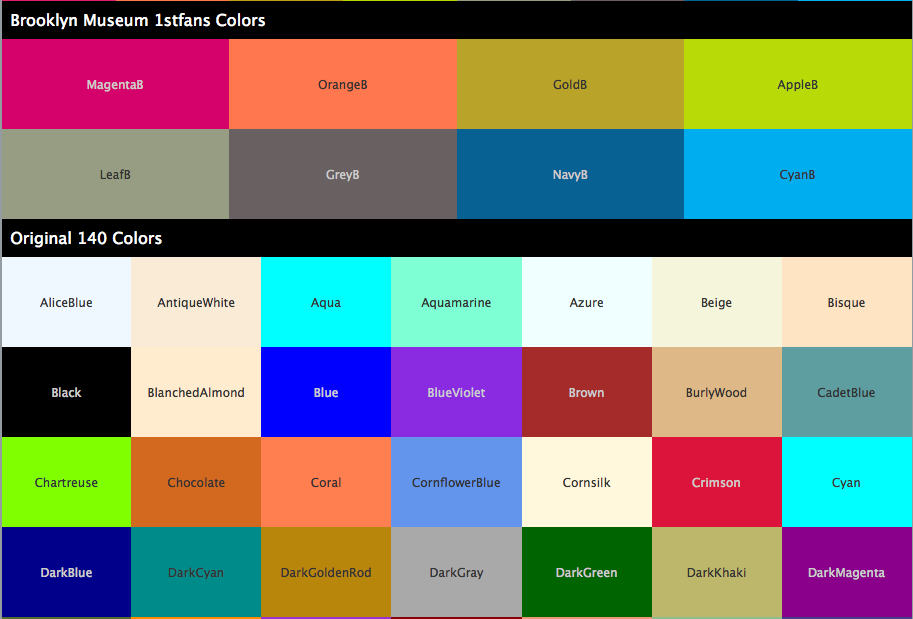
The tweets are parsed as scrolling vertical lines of colour of various widths.

The interaction is very simple right now, although Piana says he will introduce more functions as July passes. Right now I'm participating with a daily tweet, where the colour is related to the weather (so yeah, lots of greys) and the date provides the number. I'm interested to sees where this leads.
*Don't worry, I do understand that if you haven't succumbed to Twitter, all this is about as meaningful to you as 'discursive frameworks' is to me. Bear with me, and I promise the next post won't been tweety.
Wednesday, 12 May 2010
Turn to the left
Fashion exhibitions bore me to tears. I think it's the mannequins. They look as bored as I feel.
Having said that, now I'm going to blog about a fashion show. Well - two fashion shows, and the (much more interesting to me) online activity around one of them.
In January 2009 the Metropolitan Museum of Art took over the custodianship of the Brooklyn Museum's fashion collection, as the BM was no longer able to afford to maintain it. Two concurrent shows have been organised using the combined collection: 'American Woman: Fashioning a National Identity' at the Met, and 'American High Style' at the Brooklyn Museum. (Check out the Roberta Smith and C-Monster reviews).

So far, so-so. Bored looking mannequins. And then I saw Shelley Bernstein's post, where she described how Brooklyn Museum has partnered with Polyvore (a fashion-lovers website, where members get tools they can use to collage together fashion items and other visual material then save & share the results), uploading images of collection items so they can be remixed with contemporary fashion items.
My friend Nat nailed it in an O'Reilly Radar post: "the greatest challenge to heritage institutions is irrelevance, not penury. Brooklyn Museum is unsurpassed in creating relevance for its collections and its existence, and they do it by reaching out, where people are and not expecting them to come directly to us." As they so often do, the Museum has successfully taken itself out to the community, rather than waited and hoped the community might come to them.

The remix tool is available in three places; on a kiosk in the exhibition, on the Brooklyn Museum website, and on Polyvore itself.

As Shelley Bernstein notes:
I think this is a beautiful project. The only extension I can think of would be to get the writers from Go Fug Yourself to review the exhibitions (in much the way they reviewed the Met's recent Costume Institute ball).
Having said that, now I'm going to blog about a fashion show. Well - two fashion shows, and the (much more interesting to me) online activity around one of them.
In January 2009 the Metropolitan Museum of Art took over the custodianship of the Brooklyn Museum's fashion collection, as the BM was no longer able to afford to maintain it. Two concurrent shows have been organised using the combined collection: 'American Woman: Fashioning a National Identity' at the Met, and 'American High Style' at the Brooklyn Museum. (Check out the Roberta Smith and C-Monster reviews).
So far, so-so. Bored looking mannequins. And then I saw Shelley Bernstein's post, where she described how Brooklyn Museum has partnered with Polyvore (a fashion-lovers website, where members get tools they can use to collage together fashion items and other visual material then save & share the results), uploading images of collection items so they can be remixed with contemporary fashion items.
My friend Nat nailed it in an O'Reilly Radar post: "the greatest challenge to heritage institutions is irrelevance, not penury. Brooklyn Museum is unsurpassed in creating relevance for its collections and its existence, and they do it by reaching out, where people are and not expecting them to come directly to us." As they so often do, the Museum has successfully taken itself out to the community, rather than waited and hoped the community might come to them.
The interactive on the Brooklyn Museum website
The remix tool is available in three places; on a kiosk in the exhibition, on the Brooklyn Museum website, and on Polyvore itself.
Vintage, by pinkopaque22 on Polyvore
As Shelley Bernstein notes:
I often speak about going to community and engaging on their terms and this is a good example of that—we need to be reaching out, where people are and not expecting them to come directly to us. As a museum with a small tech staff, we need to be mindful of any opportunities that come our way that can save us time and coding and Polyvore fits that bill too. ... It’s rare to have an opportunity like this one that so beautifully melds all of these objectives, but keeping our eyes open to these possibilities has provided something exciting for our visitors.
I think this is a beautiful project. The only extension I can think of would be to get the writers from Go Fug Yourself to review the exhibitions (in much the way they reviewed the Met's recent Costume Institute ball).
Friday, 12 March 2010
Web muster

When Janet Cardiff's The 40-Part Motet moves out of City Gallery Wellington, I want the zebra finches to move in ....
Brooklyn Museum loads heaps more items to its online collection, includes nifty ways for users to tell how well catalogued an item is
Still have to read the article, but love the lay-out: Books in the Age of the iPad
United States Postal Service does the Abstract Expressionists (HT Walker Art Blog)
Monday, 1 February 2010
What people will pay for
When I scrolled through my overnight tweets this morning (yes, this is another Twitter-related post) I saw this, from Will Cary, the membership manager at Brooklyn Museum:

And just now I spotted this, re-tweeted from the Brooklyn Museum account:

The show they're talking about is 'Who Shot Rock and Roll', which closes today in the US (yesterday for us New Zealanders). It's been very popular, and it sounds like lines to get into the show for its final weekend are significant.
One of the benefits of a Brooklyn Museum membership is that you get to bypass the lines. A normal individual membership costs $55. Suggested admission at the Museum is $10 for adults. This weekend, more than six times the normal number of people bought a membership, presumably so they could bypass the lines. I can't see any special promotion of the queue-skipping powers of membership attached to the exhibition promotion on the Museum website, but it's strongly featured on their Twitter feed; lots of people are talking about the show on Twitter as well.
It's tempting to see this as a little parable about what will tip people over from thinking about buying a membership to actually doing it. They're not buying a discount on entry (a normal Friends benefit in New Zealand) - they'e buying something that gives them the advantage of easier access.
Contrast this with City Gallery Wellington's current Yayoi Kusama show. Friends of the Gallery get a 20% discount on the entry charge ($8 instead of $10) but no queue-skipping privileges. There don't appear to be any members-only days or extended hours for Friends - based on the above, I predict that this would have attracted a bunch of new sign-ups, especially if implemented after people had seen the crazy free Wednesday queues. It might be something for galleries hosting blockbusters to look into - after all, sometimes there's nothing nicer than flashing a card and getting waved through ....
And just now I spotted this, re-tweeted from the Brooklyn Museum account:
The show they're talking about is 'Who Shot Rock and Roll', which closes today in the US (yesterday for us New Zealanders). It's been very popular, and it sounds like lines to get into the show for its final weekend are significant.
One of the benefits of a Brooklyn Museum membership is that you get to bypass the lines. A normal individual membership costs $55. Suggested admission at the Museum is $10 for adults. This weekend, more than six times the normal number of people bought a membership, presumably so they could bypass the lines. I can't see any special promotion of the queue-skipping powers of membership attached to the exhibition promotion on the Museum website, but it's strongly featured on their Twitter feed; lots of people are talking about the show on Twitter as well.
It's tempting to see this as a little parable about what will tip people over from thinking about buying a membership to actually doing it. They're not buying a discount on entry (a normal Friends benefit in New Zealand) - they'e buying something that gives them the advantage of easier access.
Contrast this with City Gallery Wellington's current Yayoi Kusama show. Friends of the Gallery get a 20% discount on the entry charge ($8 instead of $10) but no queue-skipping privileges. There don't appear to be any members-only days or extended hours for Friends - based on the above, I predict that this would have attracted a bunch of new sign-ups, especially if implemented after people had seen the crazy free Wednesday queues. It might be something for galleries hosting blockbusters to look into - after all, sometimes there's nothing nicer than flashing a card and getting waved through ....
Saturday, 23 May 2009
Web muster
1.
Recently, Over the Net drew attention to Victor Berezovsky's new mural on the front of Freyberg Pool, and the expert committee that approved the work. This week, Ed Winkleman posted on debates around whether the public is the best judge of public art, drawing on Jonathan Jones' post about taking part in two debates on public art.
From Jones' post:
3.
More awesome from the Brooklyn Museum: they've launched a complementary game to their original collection tagging game, Tag - You're It!
Freeze Tag! encourages people to review tags that have been submitted by the public, but which have had their accuracy or relevance challenged. I've played quite a lot over the last four or five days, and it's both addictive and rewarding.
4.
A really interesting article by Robin Cembalest in ArtNews about how museum and gallery directors are reviewing their physical spaces, exhibition displays, interpretation and more, in light of both the recession and the in-reach that the social web has encouraged over the last few years via Mia Ridge)

5.
The Library of Congress releases one of Dorothea Lange's most famous images under the 'No known copyright restrictions' licence on The Commons on Flickr
6.
The Obama family is shaking up the White House decor, selecting works by Robert Rauschenberg, Ed Ruscha, Jasper Johns and Josef Alpers for display.
Image
Dorothea Lange, Destitute pea pickers in California, 1936. Library of Congress on Flickr
Recently, Over the Net drew attention to Victor Berezovsky's new mural on the front of Freyberg Pool, and the expert committee that approved the work. This week, Ed Winkleman posted on debates around whether the public is the best judge of public art, drawing on Jonathan Jones' post about taking part in two debates on public art.
From Jones' post:
It's as if we have, as a nation, turned into the board of some big company commissioning a portrait of the managing director. Or, rather, a bronze statue of John Betjeman, or maybe a gigantic homage to a sprinter like Manchester's B of the Bang (bang and it's gone). Most of the public art we're putting up is worthless.
The best interventions in public space by artists are often confrontational and controversial, from Richard Serra's Tilted Arc to Rachel Whiteread's House. All good art is private before it is public. The secret to finding great art for public spaces – and, for that matter, great art to change attitudes to disfigurement – is to find talented artists who happen to be interested in working in that arena. Then let them indulge themselves.
2.
3.
More awesome from the Brooklyn Museum: they've launched a complementary game to their original collection tagging game, Tag - You're It!
Freeze Tag! encourages people to review tags that have been submitted by the public, but which have had their accuracy or relevance challenged. I've played quite a lot over the last four or five days, and it's both addictive and rewarding.
4.
A really interesting article by Robin Cembalest in ArtNews about how museum and gallery directors are reviewing their physical spaces, exhibition displays, interpretation and more, in light of both the recession and the in-reach that the social web has encouraged over the last few years via Mia Ridge)
5.
The Library of Congress releases one of Dorothea Lange's most famous images under the 'No known copyright restrictions' licence on The Commons on Flickr
6.
The Obama family is shaking up the White House decor, selecting works by Robert Rauschenberg, Ed Ruscha, Jasper Johns and Josef Alpers for display.
Image
Dorothea Lange, Destitute pea pickers in California, 1936. Library of Congress on Flickr
Wednesday, 20 May 2009
Repeat viewing
Last night I spoke at Webstock Mini. I found it a bit overwhelming, because of the calibre of the people who spoke with me and the people in the audience, and reverted back to the state of anxiety I displayed giving my first paper to an art history crowd. Not so hardened after all ...
FWIW, here are my notes, which I didn't stick to enough. My talk was based around fandom, and refers closely to this experience.
In rooms like this, we often talk about online communities and managing online communities. If we filled this room with museum and gallery people, we’d be talking about friends groups and managing membership programmes.
But a word that I’ve been thinking about more recently is “fan”. So tonight I’m going to tell a story about art, the web, money, and being a fan.
To start off, a bit of background.
Public museums and galleries in New Zealand are largely funded by government or local councils. They do have sponsorship deals and some get money from renting out spaces and some have foundations or boards that provide financial support, but by and large they keep the doors open and the lights on and the staff employed through taxes and rates. I think that in the coming financial year we’re going to start seeing cutbacks in our museums and galleries here in New Zealand, as councils look for places to trim spending.
In America, it’s a different story. Public funding does not make up a big part of MAerican cultural institutions' budgets: most rely heavily on wealthy board members, hefty sponsorship arrangements, big membership programmes, entry fees, shop revenue and their endowments. None of these things are doing well at the moment.
To throw some numbers around:
I’ve been following this since about last October, and the numbers never really meant that much to me, until one weekend in April, when the Brooklyn Museum announced major cutbacks. The details of falling income and cutbacks have become familiar, but this time they really hit home for me.
And that’s because the Museum feels like one of my friends. I’m emotionally closer to them and what they’re doing than I am to any of my local art places. But I’ve never been there. I’ve never been to New York, and with exchange rates being what they are, I probably never will.
And yet …
I've been following them online for years. And that’s nothing out of the ordinary for museums and galleries now.
But what makes the Brooklyn Museum different is that they put names and faces and personal voices to everything they do. It’s not the Brooklyn Museum, a big stone building, talking to me: it’s Shelley from the web team and Will from memberships and Deirdre from the Library and Lisa who does stuff with the mummies.
I see their passion for what they do, in the behind-the-scenes photos they post on Flickr, and the blog article about CT scanning a sarcophagus, and the retweets of people’s cameraphone pics from their visits to the Museum. I feel like an insider. I feel special and included.
It’s by doing this that the Brooklyn Museum lets me – makes me want to be – their fan. I want to stick with them through thick and thin, as if they were a soccer team who’d just been regulated, but who I desperately want to see back in the first division.. So of course, when I heard they were in trouble, the first thing I thought was: how can I help?
Inevitably, I found the answer on Twitter. A call had gone out from one of their other web fans, encouraging people to show their support by buying one of the Museum’s US$20 1stfans memberships.
So I sat down and bought my membership. Then I jumped on my blog, and I wrote about what had happened to my friend, and I said that I’d bought a membership, and then I promised to give away 4 more memberships to readers of my blog.
Now, I know $175 New Zealand dollars isn’t going to do anything to mitigate losing $35 million from your endowment. But I felt like I had to do something, and I hoped that by spreading the word I could rally some support. At the very least, I wanted the people at the Museum who have given me so much to know that I cared.
And I guess this is what I see as a key power of the web. It gives those of us who work in public organisations a chance to open ourselves up online, not just to our customers and our users and our clients, but to the people who might want to be our fans.
In a happy coincidence, everything I love about what the Brooklyn Museum does matched exactly with what another speaker, Nathalie Hofsteede from Give a little, recommended in her talk:
FWIW, here are my notes, which I didn't stick to enough. My talk was based around fandom, and refers closely to this experience.
* * * * *
In rooms like this, we often talk about online communities and managing online communities. If we filled this room with museum and gallery people, we’d be talking about friends groups and managing membership programmes.
But a word that I’ve been thinking about more recently is “fan”. So tonight I’m going to tell a story about art, the web, money, and being a fan.
To start off, a bit of background.
Public museums and galleries in New Zealand are largely funded by government or local councils. They do have sponsorship deals and some get money from renting out spaces and some have foundations or boards that provide financial support, but by and large they keep the doors open and the lights on and the staff employed through taxes and rates. I think that in the coming financial year we’re going to start seeing cutbacks in our museums and galleries here in New Zealand, as councils look for places to trim spending.
In America, it’s a different story. Public funding does not make up a big part of MAerican cultural institutions' budgets: most rely heavily on wealthy board members, hefty sponsorship arrangements, big membership programmes, entry fees, shop revenue and their endowments. None of these things are doing well at the moment.
To throw some numbers around:
- In March the Getty Museum, the richest arts centre in the world, reduced its operating budget by 25 percent. In the second half of 2008 its investment portfolio fell from $6 billion to $4.5 billion.
- The Metropolitan Museum’s endowment generates a third of its annual budget; its endowment has shrunk from 2.9 billion to 2.1 billion, and in this financial year it plans to save $10 million in staff costs, laying off more than 10% of its employees.
- The Philadelphia Museum of Art had an endowment with a market value of $346 million in July 2008: by December it had lost 90 million off that, and were expecting to lose more.
- The Seattle Art Museum lost $5.8 million in annual rents when the bank that was its tenant fell over; its endowment has dropped by 27%.
I’ve been following this since about last October, and the numbers never really meant that much to me, until one weekend in April, when the Brooklyn Museum announced major cutbacks. The details of falling income and cutbacks have become familiar, but this time they really hit home for me.
And that’s because the Museum feels like one of my friends. I’m emotionally closer to them and what they’re doing than I am to any of my local art places. But I’ve never been there. I’ve never been to New York, and with exchange rates being what they are, I probably never will.
And yet …
I've been following them online for years. And that’s nothing out of the ordinary for museums and galleries now.
But what makes the Brooklyn Museum different is that they put names and faces and personal voices to everything they do. It’s not the Brooklyn Museum, a big stone building, talking to me: it’s Shelley from the web team and Will from memberships and Deirdre from the Library and Lisa who does stuff with the mummies.
I see their passion for what they do, in the behind-the-scenes photos they post on Flickr, and the blog article about CT scanning a sarcophagus, and the retweets of people’s cameraphone pics from their visits to the Museum. I feel like an insider. I feel special and included.
It’s by doing this that the Brooklyn Museum lets me – makes me want to be – their fan. I want to stick with them through thick and thin, as if they were a soccer team who’d just been regulated, but who I desperately want to see back in the first division.. So of course, when I heard they were in trouble, the first thing I thought was: how can I help?
Inevitably, I found the answer on Twitter. A call had gone out from one of their other web fans, encouraging people to show their support by buying one of the Museum’s US$20 1stfans memberships.
So I sat down and bought my membership. Then I jumped on my blog, and I wrote about what had happened to my friend, and I said that I’d bought a membership, and then I promised to give away 4 more memberships to readers of my blog.
Now, I know $175 New Zealand dollars isn’t going to do anything to mitigate losing $35 million from your endowment. But I felt like I had to do something, and I hoped that by spreading the word I could rally some support. At the very least, I wanted the people at the Museum who have given me so much to know that I cared.
And I guess this is what I see as a key power of the web. It gives those of us who work in public organisations a chance to open ourselves up online, not just to our customers and our users and our clients, but to the people who might want to be our fans.
* * * * *
In a happy coincidence, everything I love about what the Brooklyn Museum does matched exactly with what another speaker, Nathalie Hofsteede from Give a little, recommended in her talk:
Social media has changed the way people engage around causes and charity. The Generation G(enerous) movement is demonstrating that an online demographic can care about more serious issues than how many friends they have on Facebook. Recent times have seen our charities communicate more like corporate brands in appealing to the giving public, however its time to start the conversation again. Nathalie will explore what donor engagement can look like online and how we can help our most treasured charities bridge the gap quickly and survive a recession.
Monday, 20 April 2009
Thank you for being a friend
One of my friends is in trouble, and I want to help them out.
If they were a colleague having a stink day, I'd take them out for coffee. If they were a friend having trouble at home, I'd bake them something. But they're an art museum, and so I'm giving them what counts - my support as expressed through cash.
At the end of last week, the Brooklyn Museum announced major cutbacks (warning, PDF). Like most arts institutions in America, they're struggling as a result of the economic crisis. Their endowment has been devalued, their operating support has been cut, and their membership and fundraising revenue is shrinking.
Among the measures the Museum is undertaking, some directly affect the visitor. A major planned exhibition has been pulled; a special-exhibitions gallery will be closed; and the suggested admission fees have been raised.
And some measures directly affect staff (and thus have a roll-on effect for visitors). Staff have been told to take a one-week furlough; some are being asked to take paycuts; and a voluntary separation package is being offered. All this is being done in an attempt to "reduce personnel costs sufficiently to avoid or minimize any subsequent layoffs".
In somewhat bittersweet timing, at the same time that these announcements were being made the Brooklyn Museum was being feted at the annual Museums and the Web conference for the awesome work they do online. (If you're a regular reader of of this blog, you're probably already sick to death of hearing me go on about this .)
At the conference, Nina Simon put out a call for people to show some tangible support for the Museum, and buy a 1stfans membership. The Museum describes 1stfans as a "socially-networked" membership; it offers both 'physical' benefits to visitors to the Museum, and 'virtual' benefits to those who follow it online.
And I thought, yeah - that's the least I can do. So Sunday afternoon NZ time, I pulled out my credit card and spent US$20 on a 1stfans membership. Obviously, I don't live in New York. In fact, I've never been there (here's hoping that airline prices keep falling though). BUT....
The Museum feels like one of my friends. I've been following them online for years. They keep me updated on what's going on via Flickr and Twitter. I've learnt more about how I should be doing my job from their blog than from any course I've ever done. And I just about bloody wet myself when this year I was able to arrange for the amazing Shelley Bernstein, the Museum's 'chief geek', to drop into Wellington for a frantic 50 hours on her way back to the States from speaking in Australia.
Within hours of purchasing the membership, I'd heard from both Will Cary (Brooklyn Museum's membership manager) and Shelley, thanking me for signing up: god knows what time it was in New York. And this is exactly the kind of thing that inspires me about the Brooklyn Museum staff. Those people eat, sleep, breathe and dream the Museum: everything they do is focused on the Museum's community.
So here's what I'm doing for my friend
I'm offering to shout 4 more people a 1stfans membership. Just leave me a comment with your name & email address*, and at the end of this week, I'll draw four names out of a random number generator and get you signed up.
I know most of you are New Zealanders, and therefore this mightn't seem this relevant. So - if you know someone else who might like a membership, feel free to ask for one for them instead. If I don't get enough takers here, I'll offer the offer on to Brooklyn Museum directly, and they can give them away themselves.
And if you want to help out too, you can sign up or gift a 1stfans membership yourself.
Thanks heaps. Look forward to hearing from you.
* Don't worry, I pre-moderate comments on this blog, so your name & email won't be published. I also won't sell your contact details on to telemarketers or social media mavens.
Update: 21 April
Just backing up all the stuff I had to say already; the BM's "acceptance speech" for its Museums and the Web awards.
Thank You! from Brooklyn Museum on Vimeo.
If they were a colleague having a stink day, I'd take them out for coffee. If they were a friend having trouble at home, I'd bake them something. But they're an art museum, and so I'm giving them what counts - my support as expressed through cash.
At the end of last week, the Brooklyn Museum announced major cutbacks (warning, PDF). Like most arts institutions in America, they're struggling as a result of the economic crisis. Their endowment has been devalued, their operating support has been cut, and their membership and fundraising revenue is shrinking.
Among the measures the Museum is undertaking, some directly affect the visitor. A major planned exhibition has been pulled; a special-exhibitions gallery will be closed; and the suggested admission fees have been raised.
And some measures directly affect staff (and thus have a roll-on effect for visitors). Staff have been told to take a one-week furlough; some are being asked to take paycuts; and a voluntary separation package is being offered. All this is being done in an attempt to "reduce personnel costs sufficiently to avoid or minimize any subsequent layoffs".
In somewhat bittersweet timing, at the same time that these announcements were being made the Brooklyn Museum was being feted at the annual Museums and the Web conference for the awesome work they do online. (If you're a regular reader of of this blog, you're probably already sick to death of hearing me go on about this .)
At the conference, Nina Simon put out a call for people to show some tangible support for the Museum, and buy a 1stfans membership. The Museum describes 1stfans as a "socially-networked" membership; it offers both 'physical' benefits to visitors to the Museum, and 'virtual' benefits to those who follow it online.
And I thought, yeah - that's the least I can do. So Sunday afternoon NZ time, I pulled out my credit card and spent US$20 on a 1stfans membership. Obviously, I don't live in New York. In fact, I've never been there (here's hoping that airline prices keep falling though). BUT....
The Museum feels like one of my friends. I've been following them online for years. They keep me updated on what's going on via Flickr and Twitter. I've learnt more about how I should be doing my job from their blog than from any course I've ever done. And I just about bloody wet myself when this year I was able to arrange for the amazing Shelley Bernstein, the Museum's 'chief geek', to drop into Wellington for a frantic 50 hours on her way back to the States from speaking in Australia.
Within hours of purchasing the membership, I'd heard from both Will Cary (Brooklyn Museum's membership manager) and Shelley, thanking me for signing up: god knows what time it was in New York. And this is exactly the kind of thing that inspires me about the Brooklyn Museum staff. Those people eat, sleep, breathe and dream the Museum: everything they do is focused on the Museum's community.
So here's what I'm doing for my friend
I'm offering to shout 4 more people a 1stfans membership. Just leave me a comment with your name & email address*, and at the end of this week, I'll draw four names out of a random number generator and get you signed up.
I know most of you are New Zealanders, and therefore this mightn't seem this relevant. So - if you know someone else who might like a membership, feel free to ask for one for them instead. If I don't get enough takers here, I'll offer the offer on to Brooklyn Museum directly, and they can give them away themselves.
And if you want to help out too, you can sign up or gift a 1stfans membership yourself.
Thanks heaps. Look forward to hearing from you.
* Don't worry, I pre-moderate comments on this blog, so your name & email won't be published. I also won't sell your contact details on to telemarketers or social media mavens.
Update: 21 April
Just backing up all the stuff I had to say already; the BM's "acceptance speech" for its Museums and the Web awards.
Thank You! from Brooklyn Museum on Vimeo.
Tuesday, 10 March 2009
Giving it away.
Today I'm veering off briefly into techydom, so bear with me.
Late last week the Brooklyn Museum released a API, which allows people to display Brooklyn Museum collection images and data in their own applications. You can read more about the release and the reasons for it in this blog post. In it Shelley Bernstein writes:
It's hard to predict what might happen when you release an API like this. Wonderful things might appear, or equally you could be met with a resounding lack of interest. In the Brooklyn Museum's case, something wonderful has already popped up; a developer named David Wilkinson has built an alternative collection browser using Adobe Flex.
Typically, this is the point where I would bemoan New Zealand cultural institutions usual late-to-the-party behaviour. But late last year Digital New Zealand launched an API that brings together data from other 30 organisations, including museums, galleries, archives and libraries. In her post Shelley gave a hat tip to DigitalNZ for their work in this area, so this morning I'm feeling proud & hopeful.
Late last week the Brooklyn Museum released a API, which allows people to display Brooklyn Museum collection images and data in their own applications. You can read more about the release and the reasons for it in this blog post. In it Shelley Bernstein writes:
So, how did we get here? Recently, I was presenting at a conference in Amsterdam along with Nina Simon and Mike Ellis. Mike’s highly entertaining presentation was about encouraging the public sector to consider releasing their data so that the community of developers worldwide could take advantage and create wonderful things with it. In Mike’s own words “if you love something, set it free” and that idea was something that resonated with me. Mike is a practical guy and he talked a lot about the stresses of staffing at cultural organizations, that we can’t possibly do it all ourselves and he wanted to spread the news of the potential in allowing outside developers the chance to add their own talent and wealth to our data.
It's hard to predict what might happen when you release an API like this. Wonderful things might appear, or equally you could be met with a resounding lack of interest. In the Brooklyn Museum's case, something wonderful has already popped up; a developer named David Wilkinson has built an alternative collection browser using Adobe Flex.
Typically, this is the point where I would bemoan New Zealand cultural institutions usual late-to-the-party behaviour. But late last year Digital New Zealand launched an API that brings together data from other 30 organisations, including museums, galleries, archives and libraries. In her post Shelley gave a hat tip to DigitalNZ for their work in this area, so this morning I'm feeling proud & hopeful.
Thursday, 29 January 2009
In the first of what promises to be a series of posts, Vicki Allpress Hill of The Edge wrote on the NZ Live blog today, under the title 'Smart marketing: the answer to the recession', that:
One of the things I like about Bernstein's approach is that she treats online communication and interaction as a logical extension of what the museum has always done. From the article:
You shouldn't be thinking about starting to talk with your audience online because you can't afford print advertising. You should be thinking about it because it's your job.
Allpress Hill doesn't give any examples yet, but if you want a one-stop introduction to successful (and low-to-no cost) online relationships with your customers, check out this interview with Shelley Bernstein, web guru at the ultra-networked Brooklyn Museum.... most local organisations just can’t hope for the kind of budget that their counterparts in North America and Europe have access to. Without doubt this impacts on your ability to deliver successful marketing through the online channel, because you need money for web development, email management systems, online advertising creative and placement and staff resources to maintain it all.
The good news is this. Some forward-thinking arts marketers here are already doing it well. And the success of online marketing depends more on the things we down under have in spades: creativity, resourcefulness, collaboration, empathy with customers, attention to detail and follow-though.
One of the things I like about Bernstein's approach is that she treats online communication and interaction as a logical extension of what the museum has always done. From the article:
“There’s someone on our staff who goes to community centers and reaches out to people—it’s the same on the Web,” Ms. Bernstein said. “We really, really, firmly believe that we should be going to them, not expecting them to come to us. And also that their message is way more powerful than ours on these platforms.”
You shouldn't be thinking about starting to talk with your audience online because you can't afford print advertising. You should be thinking about it because it's your job.
Friday, 9 January 2009
Tearing down the barricades
I would love, love, love to see some New Zealand museums or galleries take part in the Wikipedia Loves Art project that's just kicking off on Flickr.
The point of the project is to gather photos to illustrate Wikipedia articles. A list of desired images will be posted at the end of Jan, and then individuals or small groups can go forth and compete to collect the most shots. From the guidelines that have just been posted on Flickr:
This could be a great opportunity to engage with the Flickr community in your area - the Wellington group in particular is very strong. You'll also be in very good institutional company: Shelley Bernstein from Brooklyn Museum put out the call this morning, and LACMA, the IMA, the V&A and the Met are all on board.
The point of the project is to gather photos to illustrate Wikipedia articles. A list of desired images will be posted at the end of Jan, and then individuals or small groups can go forth and compete to collect the most shots. From the guidelines that have just been posted on Flickr:
Qualification Notes:
1) Shots submitted must be licensed with the correct creative commons license required by Wikipedia. That's got to be either "Attribution Creative Commons" or "Attribution-ShareAlike Creative Commons". There is no resolution requirement.
2) You can only shoot works of art in the public domain, so as a general rule, only works of art created prior to 1923 will be able to qualify. This will differ from country to country, so check with the Wikimedians for general help with this.
3) Images can only be taken at participating institutions (following their guidelines posted below) and must uploaded during February 2009.
4) In the caption, your images must include the object's full identification and credit line from the object's label; your team's name; and the category this image defines so that we can assign points. Each institution may ask you to tackle getting this information in different ways, so best to see the each venue's guidelines posted below for more information.
5) Images must be your own work, submitted by you.
This could be a great opportunity to engage with the Flickr community in your area - the Wellington group in particular is very strong. You'll also be in very good institutional company: Shelley Bernstein from Brooklyn Museum put out the call this morning, and LACMA, the IMA, the V&A and the Met are all on board.
Friday, 20 June 2008
Three views
I love exhibition installation time. I think it's the intimacy with the work; art feels different in a packing case or leant against a wall to when it's fully installed.
That's why I'm really glad to see galleries writing about and posting pictures of exhibition installations, and sharing this feeling around. Three things that popped up in my feedreader today:

Kara Walker at the Modern Art Museum of Fort Worth
A post about temporary walls and crate details (no, really, you do want to read this) and a link to more construction pics on Flickr

Click! at Brooklyn Museum
The photos in this exhibition were contributed in response to an open call and judged by the community. The exhibition designer has decided to print the photos in the show at sizes that reflect their popularity with the community, an interesting physical reponse to the tag cloud aesthetic. More about the exhibition here.

The opening of the Public Gallery, West Bromwich, England
The Public Gallery is "part town planning, part regeneration, part visitor attraction, part contemporary art gallery and part media collection". A "notoriously cantankerous and rigorous" gallery designer invents a "tree structure" to cope with the architect's "interior landscape".
That's why I'm really glad to see galleries writing about and posting pictures of exhibition installations, and sharing this feeling around. Three things that popped up in my feedreader today:
Kara Walker at the Modern Art Museum of Fort Worth
A post about temporary walls and crate details (no, really, you do want to read this) and a link to more construction pics on Flickr
Click! at Brooklyn Museum
The photos in this exhibition were contributed in response to an open call and judged by the community. The exhibition designer has decided to print the photos in the show at sizes that reflect their popularity with the community, an interesting physical reponse to the tag cloud aesthetic. More about the exhibition here.
The opening of the Public Gallery, West Bromwich, England
The Public Gallery is "part town planning, part regeneration, part visitor attraction, part contemporary art gallery and part media collection". A "notoriously cantankerous and rigorous" gallery designer invents a "tree structure" to cope with the architect's "interior landscape".
Friday, 14 December 2007
The 2007 "Besties"
It's the time of the year when people start publishing their Top 10s and Best Ofs, and so Best of 3 is inaugurating the Besties.
First of: Best Online Presence
I've been incredibly impressed by the Brooklyn Museum this year. They're blogging, flickring, youtubing, myspacing, and more.
For those of you still focused on physical people through the door, it's time to think about promoting the value of the engaged virtual visitor at management level. I might visit a big exhibition at a local gallery three times, and not write about it or talk to other people about it (flatteringly).
Meanwhile, I subscribe to the BM's blog feed, I check out their Flickr page regularly, I follow their other endeavours, I write about them here, and I promote them to other people who are thinking about these kind of things. I'm more of an evangelist for these guys than I am for my local institutions - and I've never been to Brooklyn. So - what value the online visitor?
First of: Best Online Presence
I've been incredibly impressed by the Brooklyn Museum this year. They're blogging, flickring, youtubing, myspacing, and more.
For those of you still focused on physical people through the door, it's time to think about promoting the value of the engaged virtual visitor at management level. I might visit a big exhibition at a local gallery three times, and not write about it or talk to other people about it (flatteringly).
Meanwhile, I subscribe to the BM's blog feed, I check out their Flickr page regularly, I follow their other endeavours, I write about them here, and I promote them to other people who are thinking about these kind of things. I'm more of an evangelist for these guys than I am for my local institutions - and I've never been to Brooklyn. So - what value the online visitor?
Monday, 1 October 2007
Show me the blogs ....
UPDATE:
This comment was just added to an earlier post, but I'm pasting it in here:
Good for the Adam. Given the pictures below, I did consider titling this post 'Birth pangs'.
.......................................................
I've had a decent moan in the past about the lack of art gallery blogs in New Zealand. If you're thinking of rising to the challenge, you could do worse than to check out the Brooklyn Museum's blog as a model.
The blog appears to be written by staff from throughout the institution, so in the past month there's been posts on conserving a watercolour, on buying work for the collections, and on participating in the Deitch Art Parade. Sure, it's not all high-faluting art discussion, but it is an interesting - and human - insight into what goes on at the Museum.

Brooklyn Museum is also active on Flickr, posting photos of, amongst other things, exhibition installations, such as the Ron Mueck photos shown here.

Taking full advantage of the word-of-mouth possibilities of blogging, the Museum also encourages people to send them links to posts, if they've visited an exhibition and written about it on their own blogs.
PS: on an apposite note - Ed Winkleman wondered on Friday: 'Are more museums embracing blogs?'
Images: Ron Mueck, his assistant Charlie Clarke and Brooklyn Museum staff installing Ron Mueck on show at the Brooklyn Museum, November 3 2006–February 4 2007. From the Brooklyn Museum's Flickr set.
This comment was just added to an earlier post, but I'm pasting it in here:
A blog is being established by the Adam Art Gallery (Victoria University Wellington) http://www.adamartgallery.blogspot.com/
While it is still in this formative period it has not been linked from their website.
Good for the Adam. Given the pictures below, I did consider titling this post 'Birth pangs'.
.......................................................
I've had a decent moan in the past about the lack of art gallery blogs in New Zealand. If you're thinking of rising to the challenge, you could do worse than to check out the Brooklyn Museum's blog as a model.
The blog appears to be written by staff from throughout the institution, so in the past month there's been posts on conserving a watercolour, on buying work for the collections, and on participating in the Deitch Art Parade. Sure, it's not all high-faluting art discussion, but it is an interesting - and human - insight into what goes on at the Museum.

Brooklyn Museum is also active on Flickr, posting photos of, amongst other things, exhibition installations, such as the Ron Mueck photos shown here.

Taking full advantage of the word-of-mouth possibilities of blogging, the Museum also encourages people to send them links to posts, if they've visited an exhibition and written about it on their own blogs.
PS: on an apposite note - Ed Winkleman wondered on Friday: 'Are more museums embracing blogs?'
Images: Ron Mueck, his assistant Charlie Clarke and Brooklyn Museum staff installing Ron Mueck on show at the Brooklyn Museum, November 3 2006–February 4 2007. From the Brooklyn Museum's Flickr set.
Subscribe to:
Posts (Atom)